
A week in Brazil, advocating for animals
Born Free’s Policy Advisor Ian Redmond OBE reflects on a critical meeting of the United Nations’ Convention on the Conservation of Migratory Species of Wild Animals (CMS).
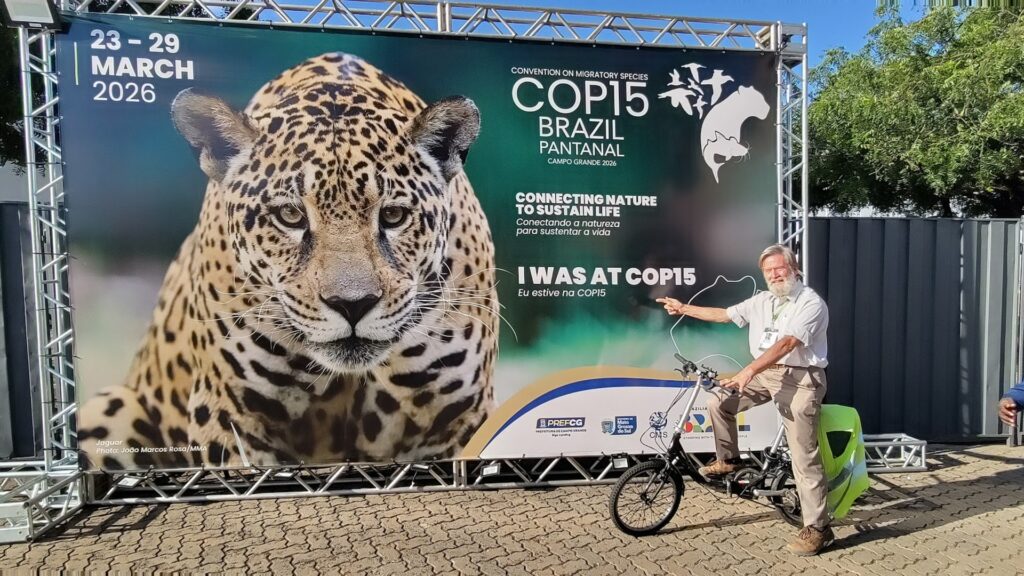
Ian Redmond OBE at the COP15 meeting in Brazil
Question: What do snowy owls, giraffes, giant otters and gadfly petrels have in common with hammerhead sharks and jaguars?
Answer: They are all endangered species whose migrations across international borders require countries to work together for their conservation – which is why they were among the 40 species on the agenda for last week’s #CMSCoP15. That is the 15th meeting of the Conference of the Parties to the UN’s Convention on Migratory Species of Wild Animals. The meeting was hosted by the Government of Brazil in the city of Campo Grande, gateway to the Pantanal – the world’s biggest wetland, itself of great importance to many migratory species.
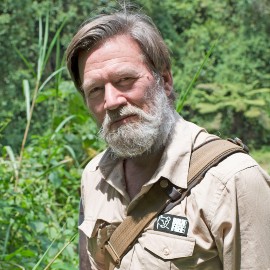
Ian Redmond OBE
It is incredibly frustrating for a naturalist to be somewhere with such amazing biodiversity and spend a week in an air-conditioned conference centre, but representing Born Free at CMS CoP15 is what I was there to do. Born Free has been an official partner NGO to CMS since 2018, and has played an active role in preparing some of the reports on cross-cutting issues such as Climate Change, One Health and Illegal and Unsustainable Take (killing) of migratory species that featured on the agenda in Brazil. Our Policy Team had also prepared comments on proposals to list on the CMS Appendices species that Born Free projects help to conserve, such as striped hyaena, giraffe and cheetah.
More than 2,000 people registered for the week-long meeting, and after the President of Brazil hosted a limited access, high-level segment to invited dignitaries (in which he encouraged countries not yet signed up to the convention to do so), the opening ceremony got under way. Formal speeches from politicians, indigenous leaders and NGO observers, and performances by tribal dancers and musicians, took up much of day one. 105 national governments were represented (out of 133 Parties – it was evident that some delegations were unable to get there because of flight disruptions in the Middle East). But once the real business began, it was clear that a huge amount of preparation had been done.
Proposals were presented, debated, and where necessary sent off to Working Groups to be negotiated, revised and brought back to the comically named CoW (Committee of the Whole) for approval. Every proposal to bring additional migratory species under the Convention’s protection was accepted by consensus – except one shark species impacted by fisheries that went to a vote, but it reached the necessary two-thirds majority and was adopted. Two proposals were withdrawn when it became clear that they did not have the support of the CoP, including one from Uzbekistan to remove the Bukhara Deer from Appendix I, which would have opened up hunting and which Born Free and the majority of delegates thought premature despite some recovery of the population.
Every lunchtime saw a range of side events, launching reports, debating policies and – it is hoped – informing delegates so they take better decisions. Born Free hosted a fascinating side event on the need to protect old, wise animals in a population – individuals often regarded as expendable and even the target of trophy hunters or fishermen. Experts on whales, terrestrial mammals and fish explained why old, even post-reproductive individuals, who carry knowledge of seasonal food resources and migratory pathways, swim-ways or flyways, play an essential role in the survival of their community. Moreover, animals who have reached old age self-evidently have strong immune systems, so their genes contribute to the health of future generations too. Thus, we argued, wildlife conservation and management should include efforts to maintain a natural age profile in the population, allowing the cultural transmission of such knowledge down the generations. This is a topic which CMS has led the way in introducing to conservation thinking, and which Born Free strongly supports – whereas representatives of the hunting industry reject it completely. Fortunately, the consensus in the room gave it a green light so respect for the elders is being recognised as important for other species as it is in human society.
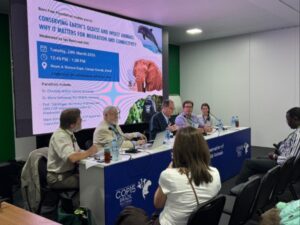
Born Free side event (c) Melanie Virtue
In my closing remarks on the final day of the meeting, I pointed out that not only has Brazil been a wonderful host, the Brazilian Government’s commitment to conservation has been evident in every intervention. This is of global significance – Brazil and its neighbours share the world’s biggest biotic pump; through evapotranspiration, their rainforests and wetlands send invisible rivers of water vapour around the world to fall as rain, watering agricultural land, filling aquifers and generating hydroelectricity – this is an ecosystem service provided to the world, but the world does not pay for it. Africa’s forests and wetlands drive the second biggest biotic pump, watering not only Africa but also feeding into Amazonia; and SE Asia has the third biotic pump. Migratory species keep these ecosystems healthy, whether through seed dispersal, nutrient cycling or as apex predators. They are the seasonal workers in the ecosystems that sustain life on Earth. The decisions taken at CMS CoP 15 will improve their chances of surviving so they can continue to play this role in the future for the benefit of us all.
However, the cost of implementing the outcomes of the meeting is challenging.
I urged delegates to set up a meeting with their Finance Ministers to talk about Natural Capital and viewing nature as an asset class. The International Monetary Fund now recommends its client countries include natural capital – the value of living nature – in the national economy – which makes Brazil one of the wealthiest countries in the world. The acronym PES – Payment for Ecosystem Services – is well–known in conservation circles but I urge you to use a new one – PESA – a word that means money in Ki-Swahili and several other languages, but in this context means Payment for the Ecosystem Services of Animals. Science can now measure the value of each individual animal’s contribution to ecosystem function over the course of his or her life. This concept can solve the biodiversity funding gap and you, my friends and colleagues, can make it happen.
That outcome would certainly make this a happy CoP!
For more information on the Convention of Migratory Species, and why Born Free engages with this important Convention, click below: