
15 incredible orca facts
Discover amazing orca facts, from their intelligence and hunting strategies to complex social lives, and learn why these marine mammals need protection.
(c) David Howitt
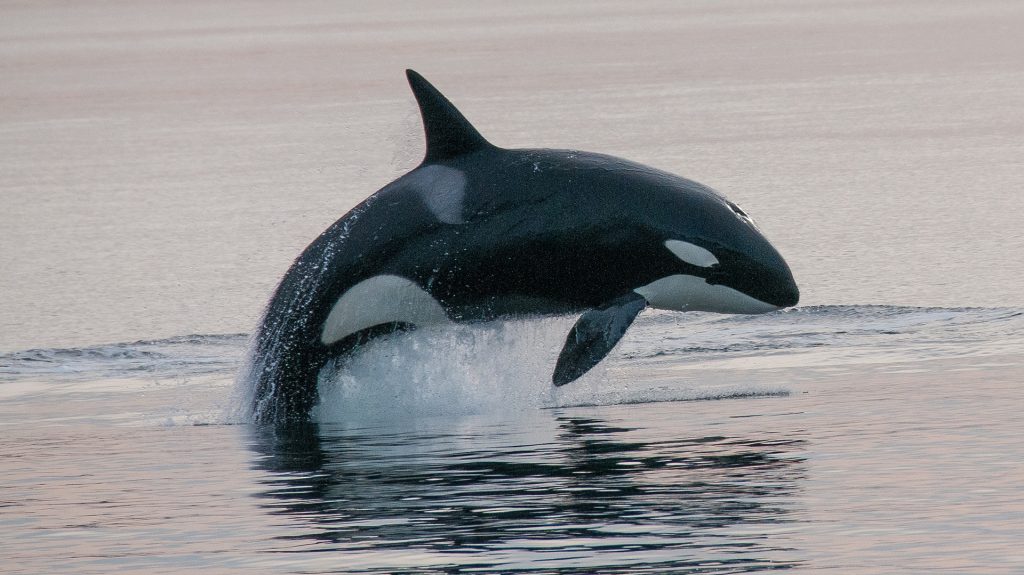
These magnificent marine mammals are highly intelligent and form strong social bonds. Orcas are apex predators that can be found all over the world, but they face several threats from human activity. Find out more with these amazing orca facts!
1. Orcas are the largest members of the dolphin family
While they are also called ‘killer whales’, a name given to them by ancient sailors who observed them preying on larger whale species, orcas are part of the oceanic dolphin family. However, all dolphins are scientifically classified as a type of toothed whale, so orcas could be considered to be both a whale and a dolphin! All dolphins are whales, but not all whales are dolphins.
Orcas are the largest species of dolphin, with adult males reaching up to nearly 10 metres in length and 10,000kg in weight.
2. Orcas are found in every ocean on Earth
Orcas are the most widely distributed of all marine mammals. They are found in every ocean, from the icy waters of the polar regions to the tropical seas. This demonstrates their ability to adapt to a wide range of marine environments.
3. There are different populations or ‘ecotypes’ of orcas
It is now recognised that there are distinct populations of orcas, known as ‘ecotypes’, each exhibiting their own longstanding and often unique vocalisations and behaviours. Despite their ranges overlapping, they are also genetically distinct and appear to rarely interact with other ecotypes.
4. Orcas are apex predators
Orcas are at the top of the food chain, having no natural predators in the wild. They eat a variety of fish, seals, squid, seabirds, other cetaceans and more. These highly intelligent animals strategically hunt in coordinated groups using methods that are tailored specifically to their chosen prey.
5. Orcas are highly intelligent animals
Orcas are known to be among the most intelligent animals on Earth. Their large, complex brains are well-wired for communicating and navigating their environment. Like other cetaceans, their intelligence is demonstrated by their ability to memorise, problem solve, socially learn and cooperate.
6. Orcas live in strong family groups called pods
(c) OrcaLab
Pods are formed of matriarchal family units made up of multiple generations. These pods contain up to 50 individuals, with the size of the pod usually depending on the population. Pregnancy lasts on average for 17 months and orcas typically reproduce every three to four years.
Unlike other animal social groups, offspring (particularly males) typically do not leave their mother when they become adults, staying with the pod their entire lives. Their strong and long-lasting social bonds are key to their learning and survival.
7. Orcas have unique dialects
Orcas have differing vocal dialects, with pods sharing their own distinct repertoire of calls, clicks and whistles. Their dialects are socially learned, being passed down from one generation to the next. These distinct dialects help pods identify each other as well as coordinate their hunting strategies.
8. Orcas use echolocation to hunt
In addition to communication, orcas produce sound to hunt prey. This is in the form of a series of clicks which is passed through the melon (a rounded organ at the front of their head) to focus the sound waves for echolocation. These sound waves bounce back as an echo, known as echolocation, allowing the orca to effectively scan their environment.
Echolocation allows prey to be detected in dark or deep water and at distances of 100 metres or more. It is thought that their echolocation is so precise that they can also identify the type of prey, such as differentiating their favourite species of fish.
9. Orcas are highly skilled cooperative hunters
Hunting strategies vary among orca populations and are dependent on the prey type. One example is ‘wave-washing’, where the orcas accelerate in a synchronised line to create a powerful wave that knocks resting seals off ice floes. Another example is ‘carousel feeding’, where orcas herd schools of fish into a tight ball and force them towards the water surface. Some members of the pod then continue herding while the others consume the fish before the orcas swap roles to ensure the whole pod gets a share.
10. Orcas have diverse diets depending on their ecotype
Different ecotypes are known to hunt specific prey, with some eating fish, and others preferring to hunt seals, dolphins or even large whales. Knowledge of what to eat, where to find it and how to catch it is socially learned. As a species, orcas have a very diverse diet, but some individual ecotypes may specialise in a particular type of prey.
11. Orcas can swim long distances at high speed
Orcas can migrate across long distances, with pods in the wild capable of covering over 100 miles a day and reaching speeds of up to 34 miles per hour. Their streamlined bodies and strong horizontal tails make them powerful swimmers.
12. Orcas are highly vocal and social
Like other dolphins, orcas communicate with a variety of vocalisations including clicks, whistles and pulsed calls. These vocalisations are needed to coordinate hunting strategies, develop their social bonds and navigate their marine environment.
13. Orcas display complex emotional behaviour
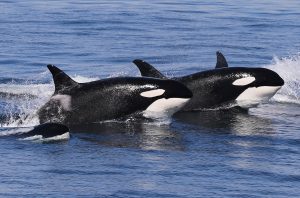 In addition to their remarkable cognitive abilities, orcas are also highly emotional animals that form strong, lifelong social bonds. From behavioural observations and studies of their brain, there is evidence that suggests orcas may be capable of expressing complex emotions such as grief and empathy.
With this current understanding of orca cognitive capabilities and their social and behavioural needs, their confinement for public entertainment cannot be ethically justified.
14. Orcas have long lifespan
In the wild, orcas can live for as long as 90 years, and this longevity is vital for transferring knowledge through the generations. Females usually live longer than males – males live to an average of 30 years and females to an average of 46 years. Sadly, in captivity, their life expectancy is often much lower.
15. Orcas face growing threats from human activity
Primary conservation threats for orca include diminishing prey availability, pollution from toxic chemicals, and boat disturbance disrupting their ability to communicate and find prey. The IUCN Red List of Threatened Species classifies them as ‘Data Deficient’ due to their vast distribution and incomplete data for certain rarely-seen ecotypes around the world. However, the Southern Resident orca population is listed as ‘endangered’ by both the United States and Canada.

LOVE ORCAS?
Adopt Springer the orca!
Springer lost her mother when she was just a baby and was too small to survive alone. She was found swimming near Seattle, USA. The entertainment industry wanted her in captivity, but Springer was identified by her unique calls and reunited with her family pod near Vancouver Island, Canada. She now swims free and has calves of her own. Springer and her family are monitored by OrcaLab. Your adoption will help us support their vital work and our conservation work.