
What happened to Jemima and Jackie, the chimpanzees?
Two chimpanzees, an adult female and her young daughter, disappeared for four years with their fates unknown… until an extraordinary discovery in the forests of Uganda.
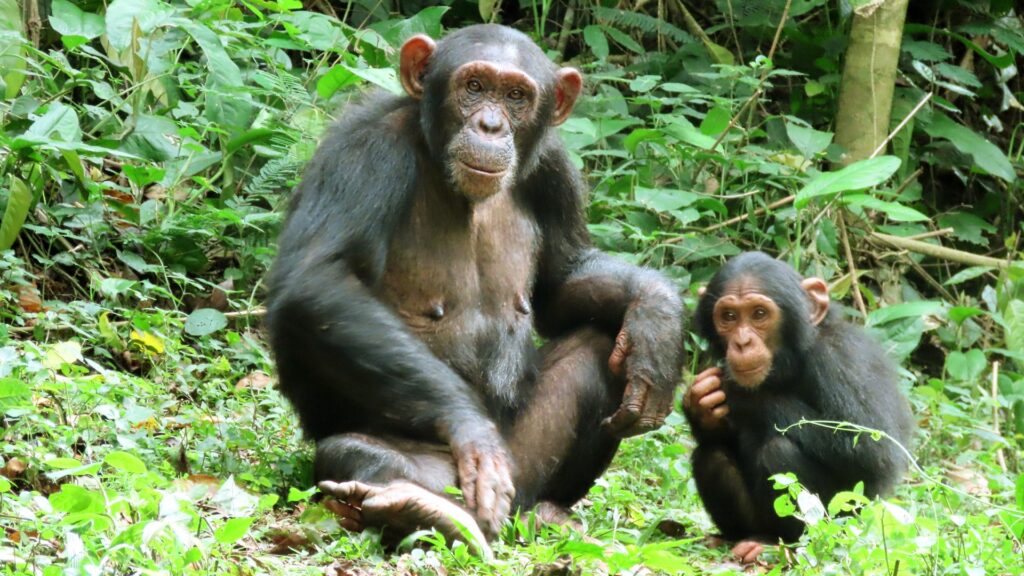
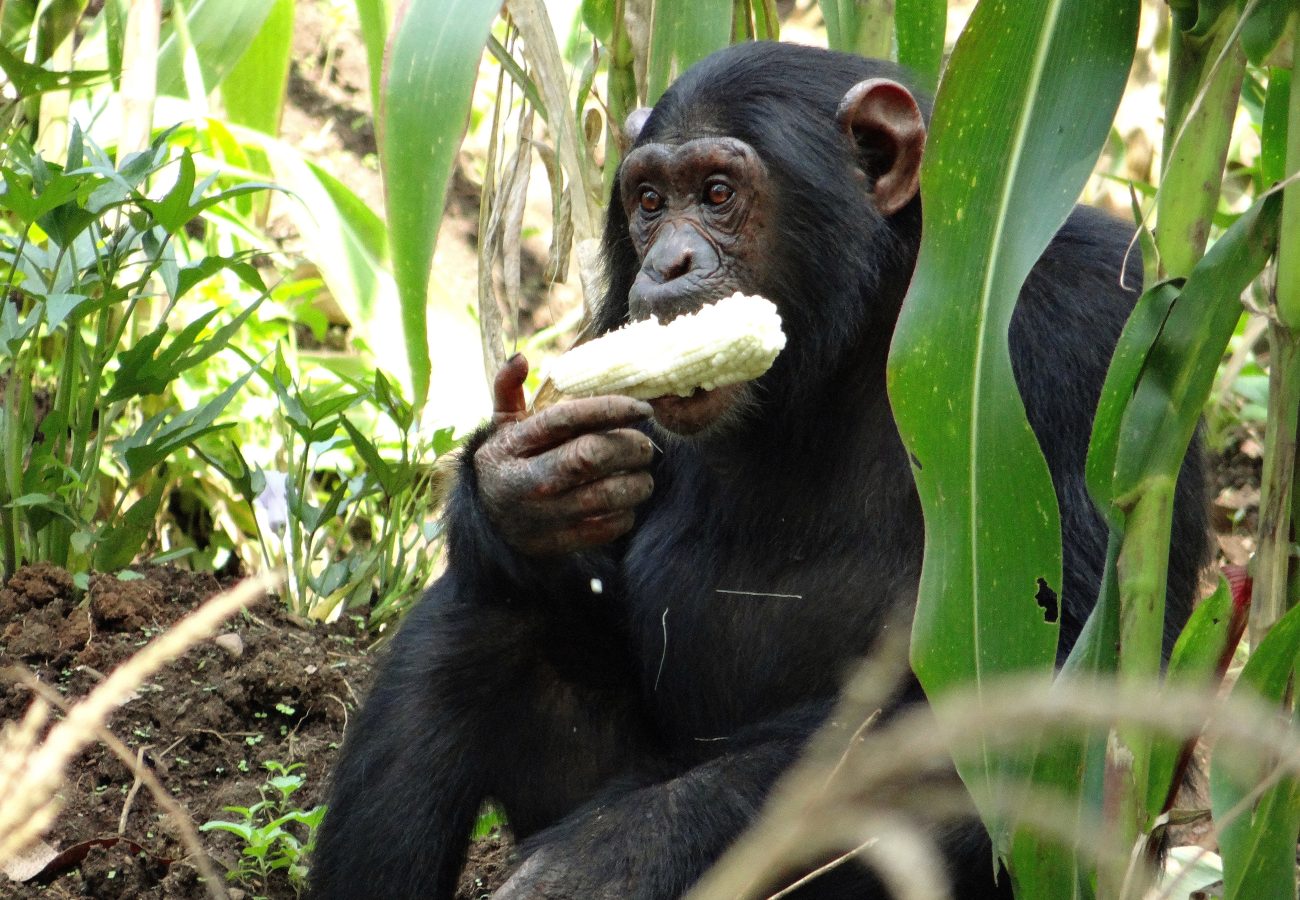
Jemima (left) and her daughter Jackie in Bulindi, before their migration (c) BCCP
With your support, Born Free’s long-term partners at the Bulindi Chimpanzee and Community Project study and protect a population of around 300 ‘village chimpanzees’, who live in the Budongo-Bugoma Corridor, an unprotected landscape linking two important forest reserves in Uganda.
These chimpanzees live closely alongside people, in a habitat made up of a mosaic of farms, plantations and forest fragments. Bulindi Chimpanzee and Community Project (BCCP) works closely with the local human communities living alongside these chimpanzee groups, to support a peaceful coexistence.
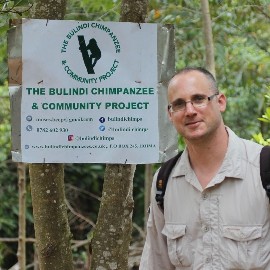
Dr Matt McLennan
Their team of Chimp Monitors follow the chimpanzee groups throughout the day, aiming to prevent harm coming to both apes and people. They gain an intimate knowledge of many of the individual chimpanzees’ lives and BCCP Director, Dr Matt McLennan, tells us a fascinating story of one of these females.
“In chimpanzee society, when young females reach adolescence, they normally leave their natal community to join another group to begin their reproductive lives,” he explains. “By doing so, they avoid breeding with close male relatives such as their fathers, uncles and brothers.
“As you can imagine, striking out alone in search of other chimpanzees can be a risky undertaking for chimpanzees, especially in the Budongo-Bugoma Corridor. Some of you might remember the extraordinary stories of two chimpanzees –Tabitha and Rosette.
“As we continue to expand our monitoring programme, to include more communities of ‘village chimpanzees’, we’re learning more about the migration patterns of young females – and the huge challenges they face,” Matt enthuses.
“The network of riverine forests and swamps that formerly served as their migratory routes have mostly been cut down and replaced by farmland, villages and towns, and the landscape is now criss-crossed with busy roads.”
While most female chimpanzees in the wild appear intrinsically driven to migrate, a minority become pregnant and give birth in their natal communities. Once they have offspring of their own to take care of, such females appear to lose their urge to migrate, and most will remain in their birth community for life. This seemed to be true for Jemima, of the Bulindi chimpanzee group.
“We first got to know Jemima in 2012 when she was a juvenile,” Matt continues. “In 2016, she gave birth to an infant when she was around 10 years old – a very young age for a female in the wild. Most likely, she became pregnant before she’d had a chance to consider migrating.
“Sadly, her first infant died during an outbreak of coughing (a respiratory infection) in early 2018. Jemima remained in Bulindi and by the end of 2018 had given birth to a second infant, whom we named Jackie. It seemed certain that Jemima would remain in Bulindi for the rest of her life.”
In September 2021, Jemima had a third infant. On this occasion, her newborn disappeared on the second day. Jemima had been behaving fearfully of the group’s males and the BCCP team suspected the infant may have sadly been a victim of an infanticide – a natural but shocking behaviour, where males kill infants who are not their own, to increase their chances of mating with the female.
“Less than two months later, Jemima disappeared from Bulindi – along with her older infant Jackie, then almost three years old. We believe the suspected infanticide forced Jemima to reconsider her options, prompting her to leave her birth community and seek a new life with other chimpanzees,” explains Matt.
“For years, we were left wondering what Jemima’s and Jackie’s fates were. Did they eventually find another chimpanzee community to join… or did they run into trouble in the human-dominated landscape along the way?”
In November 2025, now four years after Jemima’s disappearance, BCCP expanded their chimpanzee monitoring to incorporate an eighth group: the Kasongoire community.
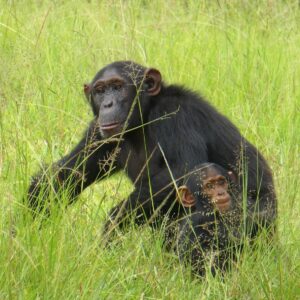
Jemima with her new infant in Kasongoire (c) BCCP
“When studying the photos and videos taken on that first day, I was intrigued by one adult female in particular. Chimpanzees, like people, have distinct features and this female bore a strong resemblance to Jemima,” said Matt. “As more photo and video evidence accumulated in the coming days and weeks, it became clear that this female was indeed Jemima – and she has a new infant. It was a great relief to confirm that Jemima made it!”
The fate of Jemima’s daughter Jackie was far less certain, however. While the new groups’ males would certainly have welcomed the arrival of a young breeding female like Jemima, they may have been more ambivalent about her infant, born to rival males. When getting to know a new chimpanzee group, it can take time to match juveniles, who are often quite independent, to individual adult females with confidence.
“Slowly, however, it’s become clear that one juvenile – a female aged around seven years (the very age that Jackie would be now) – associates with Jemima and her infant. We were delighted when it turned out this must be Jackie and she made it too!”
With the inclusion of the Kasongoire group into BCCP’s chimpanzee monitoring programme, we hope to follow the fortunes of Jemima, Jackie and her new infant in the years to come!
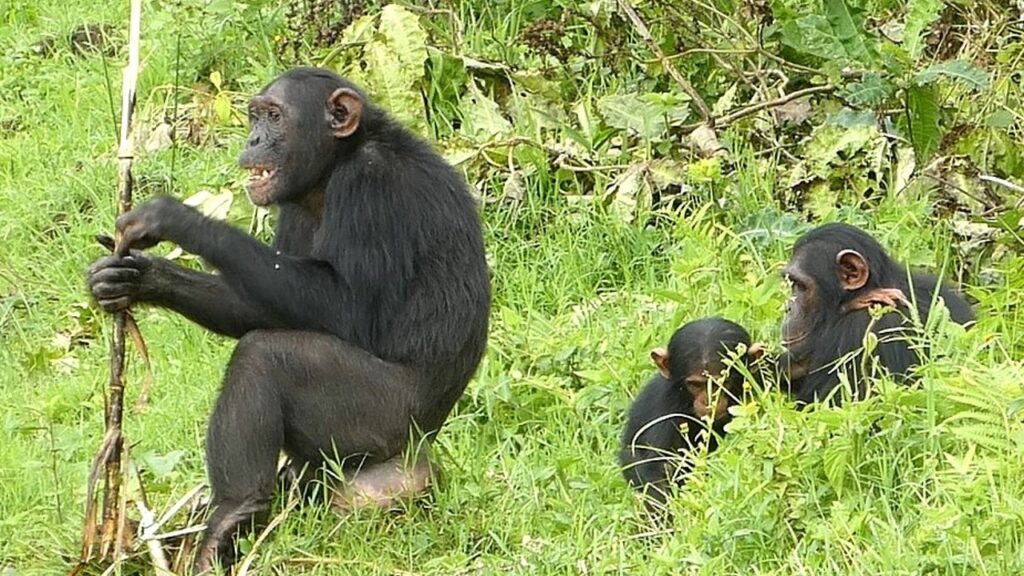
Jemima and her family, Kasongoire (c) BCCP
CAN YOU HELP UGANDA'S CHIMPANZEES?
Born Free’s partners, including BCCP, carry out vital work to protect wild chimps and other animals – but we can only continue to support them with your help. Become a Born Free regular donor from just £3 per month today, and help ensure a better future for wild animals.