
What do you do when a lion kills your cattle?
In a remarkable story of courage and coexistence, a herder in Kenya chooses peace over retaliation. A long read by our Kenyan Communications Manager, Ivy Malemba.
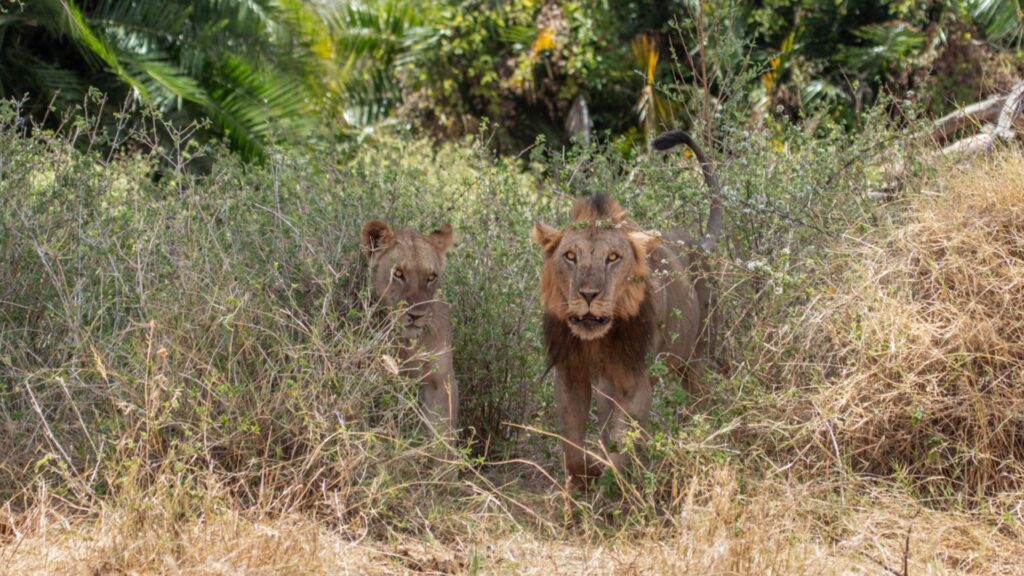
Lions in Meru (c) Born Free
Despite calls from his community to lay down poison for lions, Ismail resisted. He instead reported the attack on his cattle and became a wildlife ambassador.
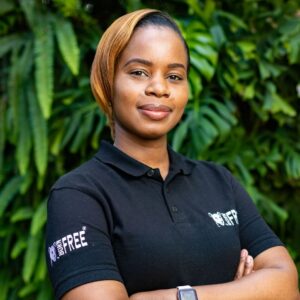
Ivy Malemba
Imagine waking up to find three of your cows dead. For most people, a cow is a farm animal. But for a pastoralist community in northern Kenya, cattle are everything. They are savings, sustenance, school fees, and security all in one. Losing even one animal can destabilise a family. Losing three in a single day is devastating.
This is the reality that Ismail Abdi Omar faced on a recent morning in the Rodgers area of Korbesa, a community living at the edge of one of Kenya’s most iconic wildlife landscapes – Meru National Park.
A morning discovery
Ismail had done what he did every day – taken his cows out to graze. He stepped away briefly for prayers, and when he returned to check on his herd, something was wrong. He began following the hoof prints of his cattle, tracing their path through the scrubland, until he came upon a scene that stopped him cold.
“I had taken the cows to graze. I went for prayers and started following the cow prints. That’s when I saw my cows were dead. I got into deep thought and decided to report the incident.”
Three cows were killed at three separate spots within the same area. The likely culprit? Lions.
Living between two worlds
Korbesa sits within a landscape where wildlife and people share the same land. The Bisanadi Reserve and Meru National Park are not distant abstractions. They are places Ismail and his neighbours depend on for dry-season grazing. In this part of Kenya, the boundary between wild and domestic life is thin, sometimes invisible.
Lions, while magnificent, are also powerful predators. A pride moving through the area at night does not distinguish between wild prey and a pastoralist’s herd. For communities like Ismail’s, this is not a news story; it is a recurring reality, one that brings grief, financial stress, and sometimes fear.
When predators strike, the instinct to retaliate is deeply human. It is not cruelty, it is desperation. And it is this desperation that makes what Ismail did next so remarkable.
The pressure to poison
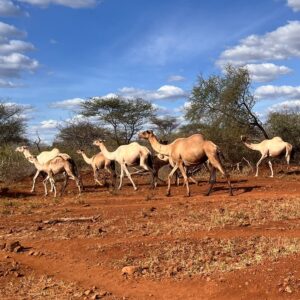
Livestock (including camels) are vulnerable to predation
Word of the attack spread quickly. Community members came to Ismail with a message: poison the carcasses. The logic, from their perspective, was simple – lions return to their kills. If the remains were laced with poison, the lions responsible would be eliminated before they could strike again.
This was not an abstract suggestion. Just weeks earlier, in a nearby area called Rapsu Guda, a young lion had been killed after feeding on a poisoned camel carcass. The practice exists, the pressure is real, and the grief behind it is genuine.
Ismail felt the weight of that pressure. In tight-knit pastoral communities, refusing to act in line with your neighbours’ expectations can feel like betrayal. Yet Ismail held firm. He said no.
Three reasons not to retaliate
When the Born Free team visited Ismail shortly after the attack to assess the situation and offer support, they asked him a straightforward question: why had he chosen not to retaliate?
He gave three answers – each one a window into a man who has thought carefully about the world he lives in.
First, Ismail explained that during Kenya’s dry seasons, he depends on access to grazing areas within the Bisanadi Reserve, and occasionally the buffer zones near Meru National Park. This means he interacts with park rangers regularly. He has come to respect them and the difficult work they do. Poisoning wildlife, he felt, would be a betrayal of that relationship.
Second, he drew a quiet but powerful parallel: just as his family depends on cattle to survive, the families of park rangers and conservation workers depend on wildlife to sustain their livelihoods. Lions are not just animals in a textbook, they are part of an ecosystem that employs people, draws visitors, and supports communities. Killing lions hurts people too.
Third, Ismail recalled a community awareness session he had attended the previous month, organised in response to an earlier poisoning case in the area. At that meeting, he learned about the ripple effects of poison, how it does not only kill the intended target, but can move through the food chain, killing vultures, hyenas, eagles, and other animals that feed on the same carcass. He came away with a perspective that surprised even him: wild animals also have a right to life.
Armed with these reasons, and despite the grief and financial loss he was carrying, Ismail walked away from retaliation and towards accountability. He reported the attack.
Why this matters
Poison is one of the greatest threats facing large carnivores across Africa. It is cheap, easily available, and devastatingly effective, not just at killing the intended animal, but wiping out entire food chains in a single event. Vultures are critically at risk, as they gather in large numbers at carcasses and can be killed in the dozens by a single poisoning incident.
When communities experience livestock losses and feel unsupported, poisoning becomes a coping mechanism, a way of asserting control in a situation that feels helpless. Addressing human-carnivore conflict is not simply about protecting wildlife; it is about understanding and responding to the very real pressures that drive people to retaliate in the first place.
This is why Ismail’s story matters so much. He did not have the luxury of not caring about those three cows. He lost them. He felt the community’s expectation to act. Yet he chose a different path, one informed by relationships, empathy, and education.
A Conservation ambassador is born
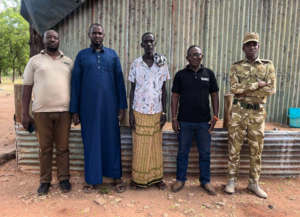
L-R: Charles Njoroge (Born Free), Kusow Abdullahi, Ismail Abdi Omar, Jeremy Kimathi (Born Free), Immanuel Lepilal (KWS).
The Born Free team commended Ismail for his courage and encouraged him to continue speaking about his experience within his community. He has since formally reported the incident to the Kenya Wildlife Service and is in the process of completing forms that may make him eligible for compensation – a process the Born Free team is supporting him through.
The team is also working to identify appropriate measures to help Ismail better protect his herd from future attacks, so that the burden of coexistence does not fall entirely on his shoulders.
But perhaps Ismail’s most powerful contribution is the one that cannot be measured in forms or fences. He is now a living example, someone his neighbours can point to and say: that man lost three cows to lions, and he did not reach for poison. He reported it. In communities where trust in institutions is still being built, that example is priceless.
Conservation is rarely won in courtrooms or conferences alone. It is won in moments like this one, in the quiet resolve of a man standing in a field, looking at three dead cows, choosing to think before he acts, and choosing peace.
The Born Free team continues to work with communities across the Meru landscape to build understanding, reduce conflict, and support people like Ismail who are on the frontlines of human-wildlife coexistence every day. Ismail will remain an important voice and contact in our ongoing efforts to promote coexistence in his community.
Support our work to promote coexistence!
Our Conservation Programme aims to directly address the most critical threats facing the world’s threatened species, while working with communities that live alongside them to reduce human-wildlife conflict. Could you help with a gift today?