
Holding on to hope, in a world of bad news
In a world seemingly full of bad news, a realistic hope for nature and wildlife can persist. Dr Mark Jones encourages us all to never stop standing up for a better future.
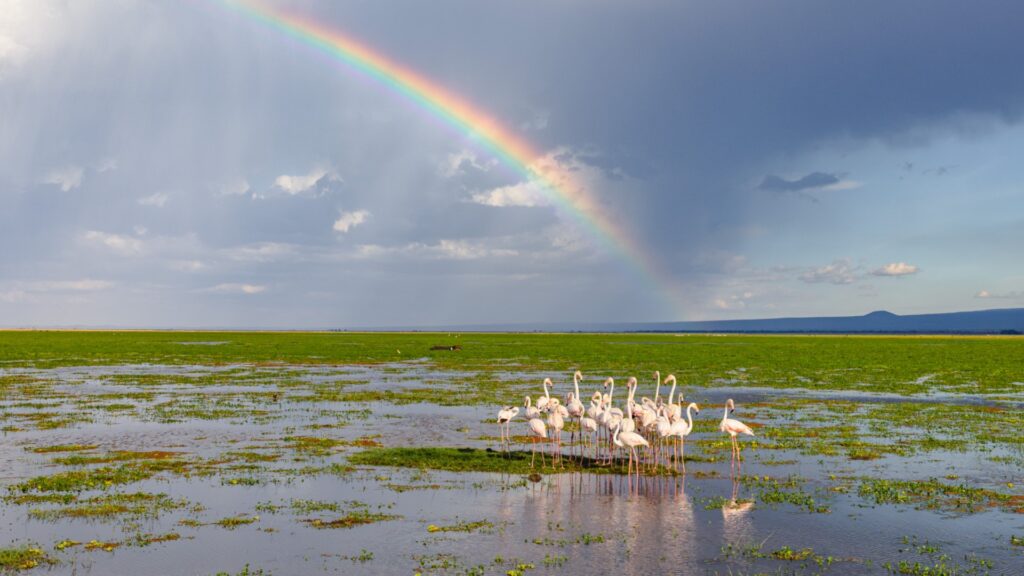
Flamingos in Amboseli National Park, Kenya (c) Peter Ndung’u
It is easy to feel overwhelmed, when we seem to be the middle of a deluge of bad news about the natural world. But, together we are strong. Our remarkable Head of Policy, veterinarian Dr Mark Jones, explores how to remain inspired, enthusiastic, and full of practical hope, even when surrounded by considerable challenges.

Dr Mark Jones
At Born Free, sadly we are no strangers to bad news. Those of us who work every day to protect wildlife understand that progress is rarely straightforward or guaranteed, and that gains for wild animals and the natural world are often fragile. Yet even by those standards, the recent cascade of setbacks for nature seems especially sobering.
Across the globe, governments that once spoke confidently about restoring nature and tackling climate change are retreating from their commitments. Hard-won promises to halt biodiversity loss and repair damaged ecosystems are being quietly diluted, delayed or abandoned altogether. This rollback comes at precisely the moment when decisive action is most urgently needed.
The warnings could not be clearer. In the UK, intelligence and security experts have publicly recognised what conservationists have long understood: the collapse of biodiversity is not just an environmental issue, but a direct threat to national and global stability and security.
Degraded ecosystems undermine food security, increase the risk of conflict, exacerbate the impacts of climate change and weaken the resilience of societies already under strain. When those tasked with safeguarding national security are sounding the alarm about nature loss, it should give every decision-maker reason to stop and think.
Internationally, the picture is no less troubling. The withdrawal of the United States from key environmental and biodiversity forums under the Trump administration sends a damaging signal at a time when global cooperation to halt and reverse nature loss is essential. At the same time, policies that expand access for hunting and fishing across vast areas of federal public land risk further normalising the idea that wildlife exists primarily as a resource to be exploited, rather than a living heritage to be protected.
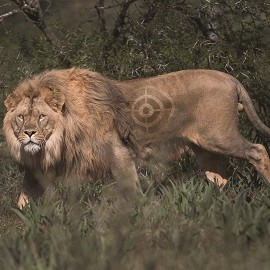
(c) georgelogan.co.uk
Elsewhere, the sheer industrial scale of wildlife killing is laid bare. Recent data from South Africa has exposed the staggering number of animals killed each year by trophy hunters, who try to justify their cruel and gruesome activities in the name of conservation. Such narratives attempt to cloak commercial hunting in the language of sustainability, while ignoring the ethical costs, ecological consequences and moral bankruptcy of treating wild animals as disposable commodities.
Taken together, these developments paint a bleak picture. They suggest a world drifting further away from respect for nature, and further still from recognising that our own future is inseparable from the fate of wildlife.
And yet, Born Free refuses to believe that this story is already written.
There is still time to change course.
Global agreements such as the Convention on Biodiversity’s Global Biodiversity Framework, adopted by the overwhelming majority of the world’s nations in 2022, offer a clear roadmap for halting and reversing nature loss – if governments choose to implement them with ambition, integrity and urgency.
(c) Nathan Anderson, Unsplash
Protecting and restoring ecosystems, ending the commercial exploitation of wildlife, and investing in coexistence rather than conflict are not radical ideas; they are essential to nature’s future, and to our own. The publication in December last year of the UK Government’s Animal Welfare Strategy for England provides a framework for increasing wildlife protection here at home, and we’ll be doing all we can to ensure the government’s stated ambitions are realised.
Equally important is nurturing a deeper appreciation for nature among the next generation. We’re often told that young people are increasingly disengaged from the natural world. Yet when young people are given the chance to experience wildlife as something wondrous and intrinsically valuable, rather than something to dominate or destroy, they become powerful advocates for change. You only have to look at Born Free’s youth ambassadors to see how powerful their voices can be.
The challenges we face are immense, but so too is our capacity to respond. And while global communication and social media networks are often used to disseminate fake news and hatred, they can also be platforms for good.
With your support, Born Free will never stop speaking out. We will always challenge complacency, stand up for wildlife wherever it is threatened, and campaign to end animal exploitation and suffering.
The bad news for nature and wildlife may appear to be mounting – but with courage, compassion and collective action, a different future is still within reach.
LOVE THE WILD?
Every year, Born Free rescues, campaigns for and protects thousands of wild animals around the world. With your support we can continue to ensure that all wild animals, whether living in captivity or in the wild, are treated with compassion and respect and are able to live their lives according to their needs.