
Encouraging empathy in young people
Should schools visit zoos and aquariums? Our free online event helped teachers and educators worldwide think about the impact on animals, giving them tools to share with students.
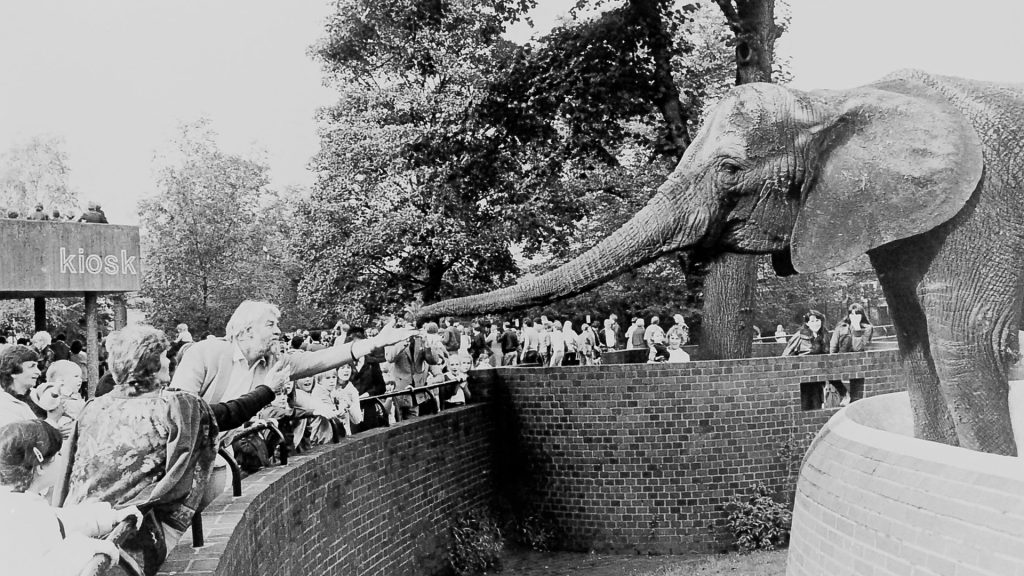
Pole Pole the elephant at London Zoo (c) Daily Mail
Building empathy is so important – this skill helps us interact with each other, and connect to the world around us. Empathy or, in its most basic form, understanding, supports better communication, reduces conflict, improves relationships and enhances teamwork, while encouraging kindness.
These are all key to interpersonal relationships, but also help us carefully consider how we think about and treat animals – including wild animals. Empathy helps ensure our actions are thought out, focusing on the needs of other animals rather than just our own, and thus helps to increase tolerance and reduce exploitation.

Charlie Smith, Senior Education Officer
“To help teachers and home-educators bring empathy for animals to life in their teaching, we recently ran a free online workshop,” explains Charlie Smith, Born Free’s Senior Education Officer. “Entitled Are zoo trips actually in the best interest of students and animals?, this was our second ‘Continuous Professional Development’ session in partnership with Empathy Week – a global festival of film and storytelling.”
Encouraging empathy, and exploring meaningful alternatives to zoo visits, the webinar was chaired by Charlie, who was joined by our Captivity Research and Policy Manager Chris Lewis, and Youth Ambassador Nikita Dhawan. A member of Born Free’s Teacher and Educator’s Council Juliet Nolan, and Junior Ambassador Leo Sordello-Savelle, also took part via pre-recorded videos.
“The session reached an incredible 129 educators, across 25 countries,” said a delighted Charlie. “Feedback showed 100% of attendees saw the importance of incorporating empathy in their work. They rated the session with 8.3 out of 10 for how useful they found it – brilliant news!”
But educator training is not the only way Born Free encourages empathy education. Our range of curriculum-linked workshops and resources also help students to build understanding and respect for wild animals.
To ensure everything we deliver is of the highest standard, we’ve been evaluating our Pole Pole-focused workshop, Should Animals Have the Same Rights as Humans? Based on the true story of Pole Pole the wild-caught elephant – whose untimely death at London Zoo led to the start of our charity – students work in groups as different ‘stakeholders’, including Pole Pole herself.
Students share their thoughts and opinions, before voting as a class whether Pole Pole should be sent to a zoo. This 90-minute session for upper primary school students is one of our most popular workshops, so we wanted to check it was truly supporting their learning.
Combining feedback from over 400 students across 14 schools, results indicate that, overall, the workshop has a positive impact on perceptions and understanding of animal welfare. Technically, the results showed an ‘effect size of 0.45 for Year 6 students, with 0.29 overall, for Years 4-6’.
But what does this mean? An effect size of 0.29 – 0.45 indicates a moderate, but meaningful, difference between the ‘control group’ (who completed both pre- and post-questionnaires before receiving the workshop), and the ‘intervention group’ (who completed a pre-questionnaire two weeks before the workshop, and a post-questionnaire two weeks after the workshop). The ‘intervention group’ had improved the most – for example moving from incorrect to correct answers between the pre- and post-questionnaires.
We hope these results ensure educators feel confident when booking Born Free sessions for their students and using our online resources. We will now use the detailed results of the evaluation to further improve the workshop and our wider school and home-educator focused outreach, where relevant.
How can you get involved?
Our accredited and certified CPD session offers an official CPD certificate for educators who take part, including after the event, up until the end of the 2025/26 summer term.

If you’re a home-educator, class teacher, or school support staff, you can use this to complete your necessary CPD requirements or just increase your knowledge while:
- Feeling confident to teach about empathy for animals using different tools and techniques
- Understanding the impact of captivity on wild animal welfare and the link to empathy
- Feeling confident to promote a culture of ‘empathy for animals’ within your school community, amongst students, parents, colleagues and school management.
In addition, visit the UK Education section of this website, to enjoy the wide range of wildlife and environmental materials we have to support you and your students, from workshops, to resources, to a free school magazine.