
Does ‘Planet Zoo 2’ game reflect reality of modern zoos?
As the second edition of the popular simulation game launches, Born Free looks at how well it really represents how zoos operate.

Elephants at Chester Zoo © Aaron Gekoski
On Planet Zoo 2’s release date, 13th October, Born Free’s Policy Support Officer Frankie Osuch breaks down some of the differences and similarities between the popular zoo simulation game, and how zoos currently operate in the real world.
- Planet Zoo 2 presents keeping large, far-roaming wild animals happy and healthy as achievable, when in reality their complex needs simply cannot be met in a zoo setting.
- Virtual zookeepers in Planet Zoo 2 are presented with the option to release animals they no longer want into the wild, increasing their zoo’s “Conservation Rating” – but in the real world, animals kept in zoos are very rarely rewilded, and ‘surplus’ animals are more likely to be sold or euthanised.
- Players are encouraged to choose animals for their zoo based on “visitor appeal rating” – despite those with the highest ratings being some of the species with the greatest identified welfare issues in captivity.

Frankie Osuch
In Planet Zoo 2, Frontier have developed a zoo simulation game that’s visually and mechanically detailed. However, during the marketing of the game, which included a livestream at Chester Zoo, I was concerned by references made to how the game aims to represent the role of modern zoos, and that they would like to see the game lead to an increase in zoo tourism.
While we know that the game will be enjoyed by many animal lovers, it’s important for players to be aware that the game depicts an idealistic portrayal of zoo management that is sadly far removed from the reality.
ANIMAL WELFARE AND ZOO MANAGEMENT PRACTICES
In creating a videogame like this, designers need to balance realism with producing an engaging game that encourages creativity and is enjoyable to play, which inevitably results in the omission of many of the difficulties and controversial management practices that are commonplace in real zoos across Europe.
The game presents an idealistic version of a modern zoo, where the welfare needs of even large, far-roaming wild animals are simply met by the provision of food, water, socialisation, enrichment and an enclosure size that meets legal minimums. It does not take into account many aspects of an animal’s biological, social and cultural needs, and some of the dangers and ailments that are specific to captivity (such as fatalities and injuries associated with enclosure design and a lack of opportunity to escape conflict).
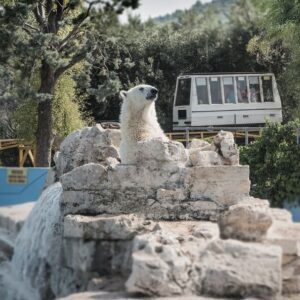
The minimum enclosure sizes for many animals in the game would not be large enough to meet the animals’ needs in real life. In 2019, and again in 2021, the game reduced the land and water space requirements for polar bear enclosures, as players wanted polar bears at their zoo but were not willing to provide the large amount of space that these immensely wide-ranging animals need.
While Planet Zoo is just a game, sadly, this same attitude is present in the many real zoo operators across the world who are still keeping polar bears in small, concrete enclosures. In the wild, a polar bear’s home range can be larger than the size of Austria!
Players can also release animals into the wild when they no longer wish to have them at the zoo, improving the virtual zoo’s “Conservation Rating”. In the new Planet Zoo 2 game, players can even visit the animals now living in their natural habitat. However, in reality, when animals are considered ‘surplus’, zoos typically either need to find new captive homes for them, or they are euthanised.
The killing of healthy ‘surplus’ animals for management purposes is sometimes referred to as ‘zoothanasia’. According to one former Director of the European Association of Zoos and Aquaria (EAZA), an estimated 3,000 to 5,000 healthy animals are typically destroyed by zoos each year across Europe. Some visitors may be unaware that the British and Irish Association of Zoos and Aquariums (BIAZA) openly acknowledges within their own Euthanasia Policy that its members can utilise euthanasia as a management tool.
RELEASING ANIMALS TO THE WILD
(c) B Jaschinski
Approximately 20 of the 210 species that appear in the first Planet Zoo game (including expansion packs, such as the ‘Conservation Pack’) are known to have been part of well-documented reintroduction projects using zoo-bred animals, such as the Przewalski’s Horse and Scimitar-Horned Oryx. Zoos often cite the same few examples of reintroduction successes that have involved zoo-bred animals in their attempts to justify the keeping and breeding of thousands of species in zoos, while in reality the contribution of zoo breeding programmes to successful conservation reintroductions is very small.
Most reintroduction projects do not use zoo-bred animals and instead largely rely on local governmental agencies or NGOs. The ability for zoos to contribute animals (particularly larger vertebrates) for successful reintroduction projects is ultimately limited by commercial, spatial, logistical, biological, morphological and behavioural factors that are inherently found in public zoo settings. Sadly, the reality is that the vast majority of animals in zoos are bred and displayed at great expense and without any likelihood that they will ever live in the wild.
The Convention on Biological Diversity and the International Union for the Conservation of Nature (IUCN) both recommend that species found within the country in which the zoo is located should be the focus of breeding programmes for reintroduction. Despite this, zoos typically breed and display species whose wild home is far away from the country where the zoo is located. A recent study by the University of Brighton found that just 9% of species kept by BIAZA-accredited British zoos were native to the UK, with only 2% being priority species.
WHICH SPECIES ARE PRIORITISED?

(c) A Gekoski
In order to attract more visitors, zoos often prioritise keeping larger, charismatic species over other species which may require less space, are less expensive to keep, may have fewer identified welfare problems in captivity, may be in greater need of conservation action, and may have a higher chance of successful reintroduction to the wild, such as some amphibians, invertebrates, and fish.
Interestingly, this is reflected in the Planet Zoo game by having an animal’s “visitor appeal rating” being dependent on the species and the age of the animal. The animals with the highest appeal include elephants, polar bears, big cats and great apes, all of which are sadly associated with significant welfare issues in captivity, as evidenced by Born Free’s own investigations. Of the 210 species that appear in the first game, 99 (47%) are threatened with extinction according to the IUCN Red List. In comparison, a study of British zoo stocklists in 2021 found that only 27% of species housed in Consortium of Charitable Zoos member organisations are threatened with extinction.
CONSERVATION CONTRIBUTIONS
In addition to a Conservation Rating, players are also tasked with increasing their zoo’s Guest Education Rating, mostly through animal talks and adding information boards. However, in real life, it is not that simple.
For example, a study at Chester Zoo found that only 10% of 3,890 zoo visitors stopped at any of the 97 educational interpretations, and those who did only stopped for an average time of seven seconds. Despite an increase in zoo visitor studies over the past two decades, there is a lack of evidence that zoos promote long-term pro-conservation behaviours in their visitors.
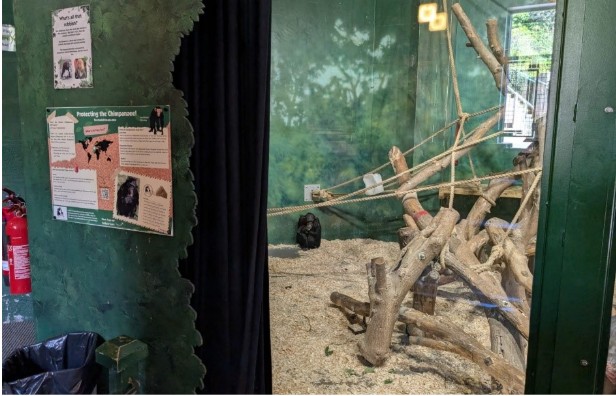
An image of a chimpanzee in a zoo enclosure with an informational sign about chimpanzees in the wild positioned next to the viewing window.
Arguably, a zoo’s most tangible contribution to wildlife conservation may be financial, yet zoo visitors may be surprised to know that typically less than 5% of their turnover is used to support projects in the wild, such as habitat management and restoration.
Some zoo research projects do benefit conservation of animals in the wild, such as the wildlife monitoring and reserve restoration projects that are part of the new game, but frustratingly a lot of zoo research efforts instead concentrate on managing and breeding captive animals, particularly mammals.
WILL THERE BE ANOTHER PLANET ZOO GAME?
While it’s of course very early to be discussing the release of the next game, what I would love to see is a “Planet Reserve”, with a focus on rewilding projects and habitat maintenance and restoration, building upon the intricately designed animal and environment models that have been created by the developers. This would also open the opportunity to feature and educate players about many more wild animals and their natural habitats, including those that are not in the Planet Zoo games for ethical reasons, such as whales and dolphins.
In the UK alone, there are around 300 zoos, but over 1,800 local nature reserves, including council and charity run reserves, woodlands, botanical gardens and city parks from which to draw inspiration. At a time when the UK is recognised as one of the most nature depleted countries in the world, encouraging care for and engagement with your local wildlife in a natural setting has never felt more important.
For fans of the game, Planet Zoo 2 looks set to offer an immersive experience at the helm of a zoo, and introduces some important themes around conservation and rewilding. However, any comparisons between your virtual zoo’s operations and real-world zoos need to be taken with a very large pinch of salt. The contributions zoos make to animal welfare and conservation may have improved over the past century, but an idealistic zoo model where it’s feasible for all wild animals to have their needs met in a zoo enclosure and be viable candidates for release into the wild remains as fantastical as any fictional videogame world.