
Can an elephant ever really thrive in a zoo?
New research claims elephant survival in zoos has improved, but fails to demonstrate that inherent welfare issues have been addressed.
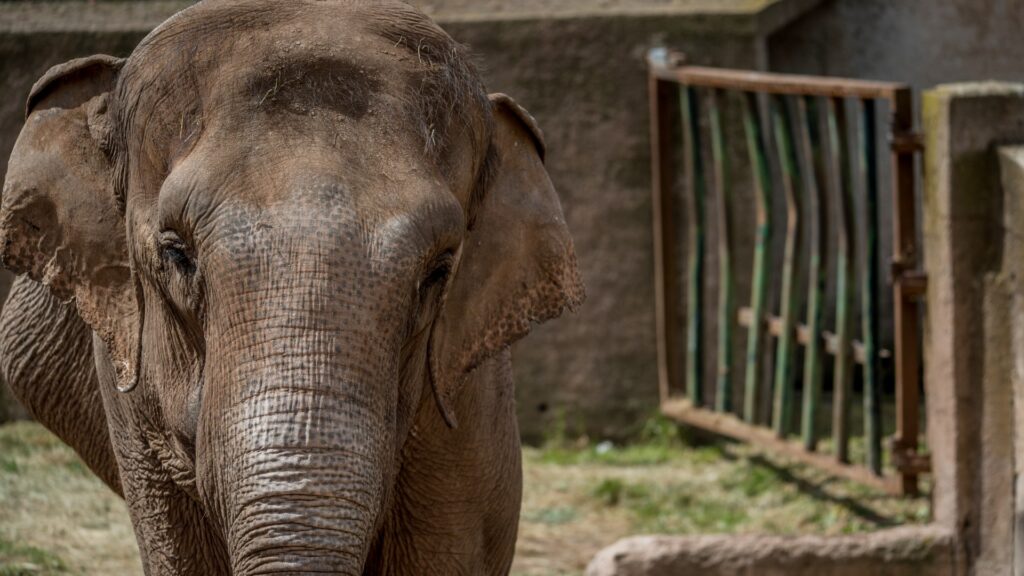
© J McArthur
“Improvement is not the same as adequacy, and adequacy is not the same as freedom.”
A new Scientific Reports paper is arguing that zoo elephants are living longer than in previous decades, challenging the idea that elephant survival is inherently compromised in zoos. But, is it really the good news some claim it to be? Born Free’s Captivity Research & Policy Manager Chris Lewis considers what the report has found, and where the real issues lie.

Chris Lewis
The new study into elephants in zoos analysed African and Asian elephant records from Species360’s Zoological Information Management System between 1960 and 2024, comparing two time periods, 1960 to 1992 and 1992 to 2024, with selected wild or semi-wild populations in Kenya and Myanmar.
The paper, funded by the Zoological Society of London (ZSL) and Species 360, reports increases in life expectancy for female and male elephants in zoos, concluding that zoo survival is now comparable to, or higher than, that recorded in wild or semi-wild comparison populations.
However, the reported average estimated life expectancy ranges from 30 years (African male savannah elephant) to 40 years (Asian female elephant). This is still far below, and in some instances, half what the maximum ages elephants in the wild can reach. This is despite elephants in captivity living without the environmental and anthropogenic threats of their wild cousins and having veterinary care available when required.
Elephants are not only long-lived mammals; they are wide-ranging, intelligent, and socially complex animals whose welfare depends on choice, movement, relationships, environmental richness and behavioural freedom. Born Free has long highlighted the multitude of welfare problems facing captive elephants, including unnatural social groupings, solitary confinement, disease, obesity, foot and joint problems, stereotypic behaviour, restricted space, cold climates and high infant mortality.
A criticism from zoo industry representatives of Born Free’s Legacy of Shame report in 2022 was that “the problem with the report is it goes right back to the era when elephant welfare was not good”. Born Free’s data within the report, which exposed the plight of elephants in zoos, was based on up-to-date information and featured accompanying case studies. By contrast, the recently published ZSL study compares data from over 60 years ago!
Ironically, comments from individuals from the zoo industry in 2022 relating to Born Free’s report, such as “I would argue that they have got some of this wrong. They are basing this on a lot of historical data… That’s going back fifty years or more”, are arguably more applicable to this recent study. To echo the words of the zoo industry, elephant welfare was even worse in the mid-to-late 1900’s than it is today, therefore the baseline for elephant zoo longevity was set incredibly low to begin with. This results in average estimated life expectancies which are still relatively low. The observed ‘improvement’ in longevity should not be taken in isolation and must be considered in combination with other assessments of elephant welfare.
The central question is not simply whether some elephants survive longer in captivity than they once did. It is whether a zoo can ever provide elephants with the physical space, social complexity, autonomy, climate, stimulation and family structures they have evolved to require.
Importantly, the ZSL study itself concedes that “longevity alone is not an adequate measure of welfare, as elephants are capable of surviving for many years while still experiencing poor physical or psychological health. A long lifespan does not necessarily indicate a healthy or positive life experience”.
The Elephant Welfare Group (EWG) report, mandated by the UK government and published in 2021, highlights a number of concerning issues which continue to affect elephants in UK zoos.
These include:
- No captive elephants survive to reach maximum ages seen in the wild (75-80yrs)
- Median longevity of captive born elephants remains <20yrs due to high early mortality, older individuals are predominantly wild caught individuals
- First year mortality 3x greater than observed in the wild
- Elephants reach sexual maturity and are bred at too young of an age
- 74% of elephants have foot issues, similar to observations made in 2006
- A third of elephants demonstrate stereotypic behaviour
- Mean adult female group size is just 2.7 compared to wild group sizes of 6 – 60
- 50% of zoos do not provide free indoor/outdoor access throughout the year.
The ZSL study reports that infant survival (surviving to age one) in the latest zoo period remained lower than the wild or semi-wild comparison populations for African females and for Asian elephants of both sexes.
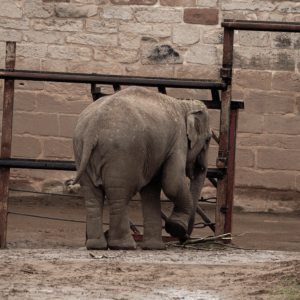
(c) Aaron Gekoski
Elephants in zoos do not live in social groups resembling those of their wild counterparts. They experience a particular enclosure, a particular social group, a particular management regime, a particular climate, and particular choices about breeding, transfers and handling. Every aspect of their lives is controlled by people. Their lives and conditions can remain unchanged for decades. A population-level increase in average survival can mask serious suffering at individual facilities and the failure to provide a facility-level comparison is a major weakness from a welfare standpoint.
The wild comparisons also need careful interpretation. The African elephant comparisons are drawn from Amboseli and Samburu in Kenya, the latter drawing on data from a research paper which acknowledges survivorship in Samburu as being significantly lower than other comparable populations. The Asian elephant comparison is with a semi-wild captive-born timber elephant population in Myanmar.
The paper explicitly includes human-caused mortality in the African wild comparisons because many wild populations face serious anthropogenic threats. This risks turning a tragedy of human pressure on wild elephants into a misleading benchmark for elephant longevity in captivity. Zoos should not claim ethical credit because elephants may live longer than animals who face poaching, conflict, habitat fragmentation or timber-camp exploitation. Neither should the continued keeping of elephants in zoos be seen as a solution to the threats they face in the wild.
Instead, stronger habitat protection, the promotion of coexistence, anti-poaching work and community-based conservation should be further supported and developed.
The study may well reflect improvements in veterinary care, nutrition, husbandry and record-keeping in some parts of the zoo world. However, improvement is not the same as adequacy, and adequacy is not the same as freedom. If an elephant lives longer in a restricted environment but spends that life without meaningful autonomy, appropriate space, natural social structures or the ability to express the full range of elephant behaviour, its longevity alone cannot be treated as a moral vindication.
This paper should not be used as justification for the continued keeping, breeding and importing of elephants for display. At best, it shows that some zoos have reduced some mortality risks over time. It does not demonstrate that captivity can meet elephants’ complex welfare needs, nor that elephants should remain a feature of zoo collections.
We must stop asking the wrong questions, like how long can we keep elephants alive in zoos. Instead, we should be asking politicians, zoo owners and keepers and members of the public whether they should be there at all.
Born Free continues its call for an Elephant-Free UK through a carefully planned and humane phase-out. End imports, end captive breeding, invest in the best possible lifetime care for those already confined, and redirect conservation resources toward protecting elephants in the wild.

STAND WITH US FOR AN ELEPHANT-FREE UK
Born Free believes that captivity cannot possibly provide elephants with what they want or what they need. Zoos and other captive facilities cannot replicate the highly complex social and physical environment that elephants have evolved to live in. Enough is enough. We're calling for a phase out. We want an elephant-free UK.