
Bushbaby rescue
Our long-term partners at Zambia Primate Project recently took in one of their smallest animals ever – a tiny lesser bushbaby who needed round-the-clock care.

Rescued bushbaby (c) Game Rangers International
One of the world’s most successful primate rehabilitation and release projects, our colleagues at Zambia Primate Project rescue baboons and vervet monkeys from across Zambia, in south-central Africa. Their team is hugely experienced, but they recently had to care for an entirely new species – their first ever lesser bushbaby. Just a tiny infant, he weighed less than 50g – as light as an egg.

(c) Game Rangers International
Supported by Born Free since 2002, and now under the umbrella of the Game Rangers International conservation organisation, Zambia Primate Project (ZPP) has successfully rehabilitated and released hundreds of primates over the years. Most of these are chacma, yellow and Kinda baboons, as well as vervet monkeys – all native to Zambia.
“ZPP has become expert at caring for young primates,” explains Anna Cryer from our Conservation team. “These including many vulnerable orphans, rescued from the illegal pet trade, after their mothers were killed for meat. While the rehabilitation of baboons and vervets is by no means straightforward, the ZPP team has a wealth of experience.
“But then a juvenile lesser bushbaby (Galago senegalensis) was discovered, clinging to a flowerpot on the porch of a private home. He was spotted during the early morning hours by the house residents, who regularly observe these nocturnal primates on their property. They immediately realised the infant’s presence in such an exposed location was highly abnormal.
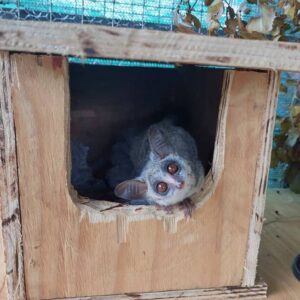
(c) Game Rangers International
“At this young age, bushbabies are usually concealed in secure vegetation while the mother forages nearby. His visible presence suggested he had very sadly become separated from his mother, and urgently needed care if he was to survive.”
The tiny bushbaby was transported to the safety of ZPP’s nursery facilities, within Lusaka National Park, one of the smallest mammals ever admitted into their care. Thankfully, despite his extremely small size, he was alert, responsive, and displaying strong behavioural indicators for recovery.
Placed into intensive nursery care, the ZPP team provided the juvenile with round-the clock care, tailored to the species’ specific developmental needs. This included keeping him warm and hydrated, with regular feeds of a special milk formula through a syringe, and minimised stress. Throughout this period, he showed good progress, remaining active and increasingly confident.
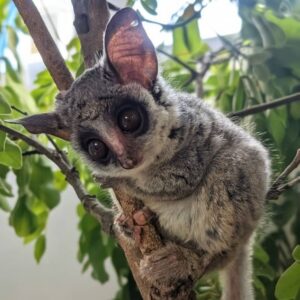
(c) Game Rangers International
The ZPP team was delighted to see the lesser bushbaby making significant progress. He nearly tripled in body size and transitioned successfully from milk feeding to tree gum, insects, and other wild food items – natural components of bushbaby’s diet.
As he grew, he became more confident at climbing and leaping – vital skills for life in the wild. He was also increasingly becoming nocturnal – being active at night is another bushbaby trait. Once the youngster began to successfully catch live insects, it was clear he was ready for release back to the wild, where he belongs.
To ensure he has the best start to his life back in the wild, supplemental food is put out at his release site and, thanks to a camera trap placed by the food, the team knows he visits every so often – but not every day, an excellent sign that he is now able to forage and fend for himself.
Without ZPP’s expertise, this little bushbaby’s story could have been very different. Born Free is proud to support Zambia Primate Project’s incredible work and ensure wildlife remains in the wild, where it belongs.

WANT TO HELP?
Donate to Born Free today to support our vital conservation and animal rescue work.