
27 fantastic facts about elephants
Elephants are incredible! But don’t take our word for it. Find out more about these amazing animals with our fascinating factoids.
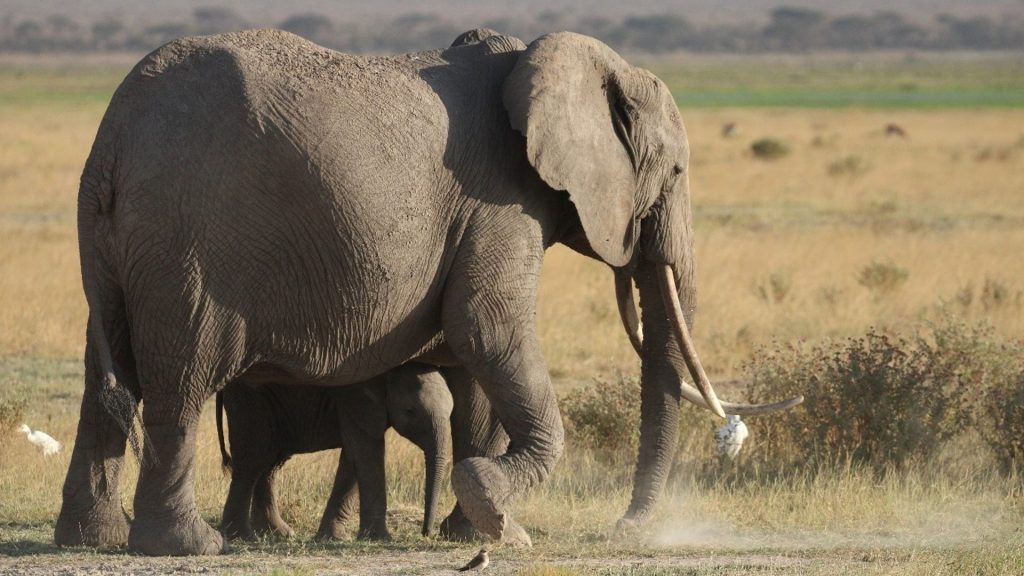
1. There are three species of elephant
One in Asia (the Asian elephant) and two in Africa (the African savannah and the African forest elephant). Asian elephants and African savannah are both classified as ‘Endangered’ by the IUCN, while African forest are ‘Critically Endangered’.
2. African elephants were once considered a single species
Until 2021, African elephants were considered a single species, with forest elephants a subspecies. However, recent studies showed their DNA differed significantly, and in 2021, the two were recognised as distinct species.
3. African savannah elephants are the world’s largest land animal
Adult males, known as ‘bulls’, can reach over 6,000kg in weight and stand over 3m tall!
© George Logan
4. Elephant trunks are extremely sensitive
Trunks contain no bones, but are made of 17 muscles, with up to 150,000 ‘fascicles’ – bundles of muscle fibres surrounded by connective tissue.
5. Trunks hold up to eight litres of water
But did you know that elephants don’t drink through their trunks? They use them to suck up water then squirt it into their mouths.
6. Trunks are also used to reassure calves
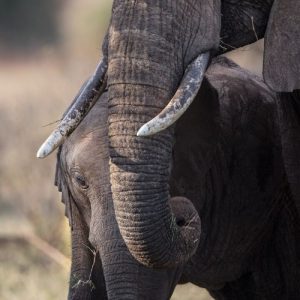
Using the trunk to touch the mouth of another elephant is a common behaviour, including a mother reassuring and protecting their calf. Conversely, calves can use this behaviour to request food from mum.
7. Trunks can be used as a snorkel
Elephants can often be found wallowing and wading through swampy waterlogged areas, making their trunk a useful appendage where the water gets deep!
8. Elephants are excellent swimmers
Elephants’ huge bodies give them buoyancy and they’re surprisingly strong swimmers. They have even been known to swim in the sea. They can swim for up to six hours and cover 48km (30 miles).
9. Ivory tusks are actually teeth
However, tusks protrude beyond an elephant’s mouth. They are made of dentine (a hard bony tissue), the same tissue that makes up our own teeth, wrapped in hard enamel to protect the tusk from wear and tear.
10. Elephant tusks never stop growing
Elephants with at least one tusk weighing over 100 pounds (45 kilograms) are called ‘super tuskers’. Sadly, they are a particular target for trophy hunters.
11. Tusks can be used for sourcing essential minerals
In Mount Elgon National Park, elephants use their tusks to mine for salt in underground caves – elephants require minerals in their diet, including sodium, which they get from natural salt deposits. In Kitum Cave, Mount Elgon National Park, in Kenya, elephants hoover up loose rocks with their trunks or use their tusks and immense strength to break off rocks containing the sodium-rich salts.
12. Elephants have incredibly thick skin
Their skin is 2.5cm thick in most places! This might not sound like much, but human skin is on average just 2mm, over ten times thinner than elephant skin.
13. Their wrinkles keep them cool
The folds and wrinkles on an elephant’s body help to retain water, keeping them cool. Wrinkled skin retains ten times more water than flat skin.
14. Elephants love a bath!
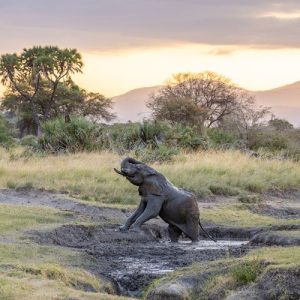
Regular mud and dust baths help keep elephants’ skin clean and protected from the sun.
© George Logan
15. Elephants eat up to 150kg of food per day
Their large bodies require a lot of fuel, meaning they spend up to 75% of the day eating. Their diet is varied, constituting grass, leaves, fruits and roots when available. In dry harsher seasons, elephants will even eat the woodier parts of trees such as twigs, branches and bark.
16. Elephants can produce over a tonne of poo a week
With all the food they consume, elephants unsurprisingly produce a lot of dung. A single elephant can produce up to 150kg of poo every day; that’s over a tonne within a week!
17. Elephants have sophisticated communication
Individuals may not always be in sight of the rest of their herd so elephants communicate using low and complex rumbles that can travel for several miles. Astonishingly, recent research suggests that elephants may even use names, changing their rumbles depending on who they’re communicating with, giving each a unique vocal label.
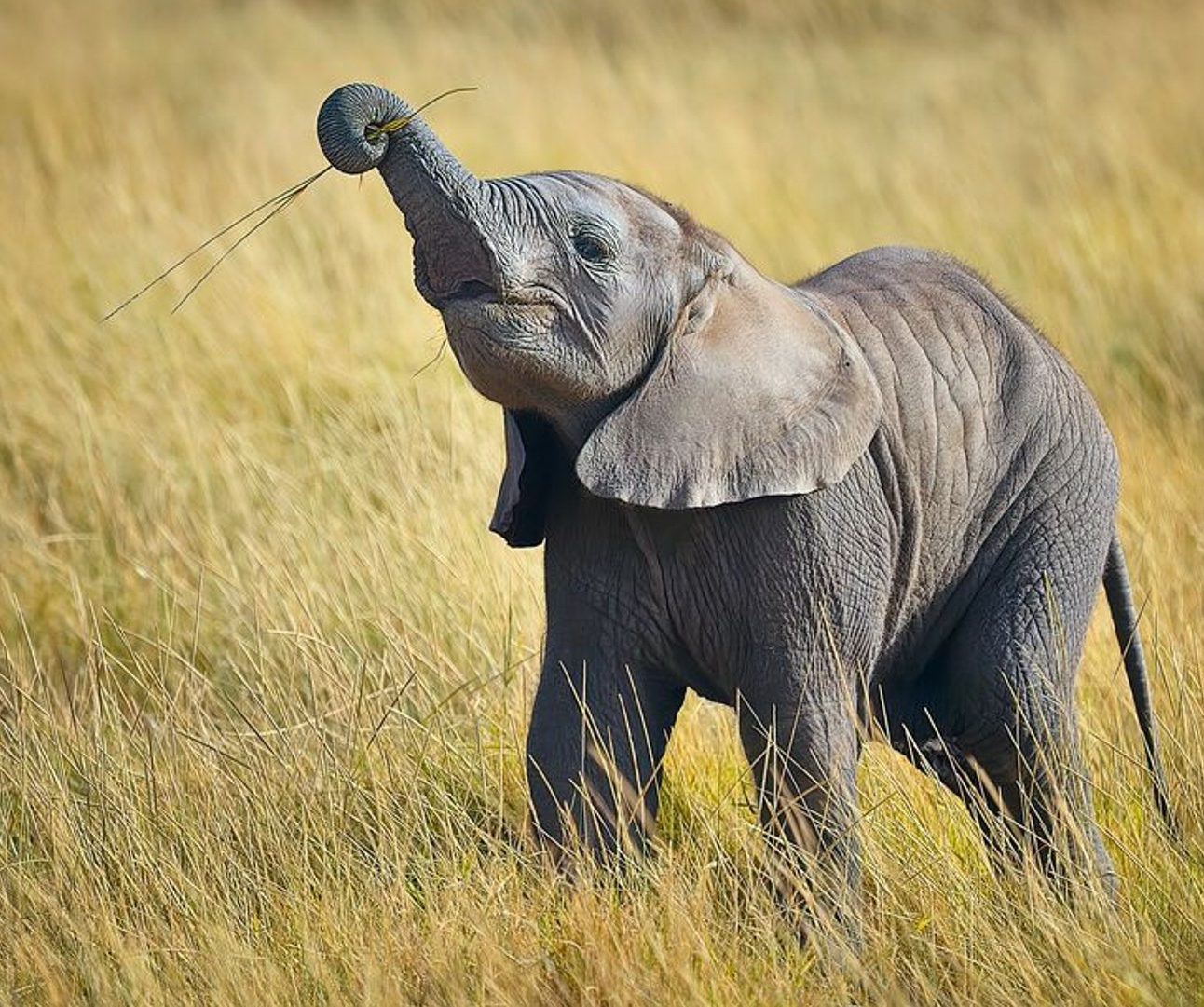
18. Elephant calves are big
A baby elephant can weigh more than 90kg (almost 200 pounds) at birth. Asian elephant calves can weigh up to 113kg (250 pounds) when born.
19. Elephant calves can stand within 20 minutes of birth
Elephants constantly migrate to find enough food and water for the herd. Even newborns must be able to keep up and calves are able to stand within 20 minutes and walk within the hour. They only need two days to be able to walk quickly enough to keep up with the herd.
20. Elephants have the longest pregnancy of any living mammal
African elephant pregnancies last on average 22 months, whereas Asian elephant pregnancies last 18-22 months.
21. A female elephant can give birth to many calves during thier lifetime
Despite having a slow reproductive cycle, with females usually having a single calf every four to five years. Over their lifetime, females can give birth to up to 12 calves; however, this is rare.
22. Elephants have heavy brains
An elephant’s brain weighs on average 4.8kg, making it the largest brain in any living or extinct terrestrial animal. Their brains are, on average, over three times larger than human brains.
© Will Burrard-Lucas
23. Elephants feel deep emotions
Elephants are emotionally complex and display behaviour consistent with empathy. They have even been shown to express grief for lost herd members, repeatedly visiting the bones of a deceased family member and carefully touching or caressing bones.
24. It is not clear whether elephants can run
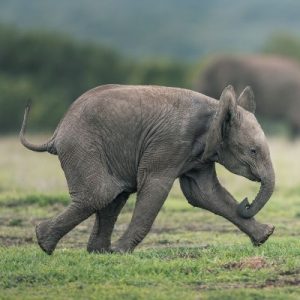
Despite their size, elephants can move faster than you might think, reaching up to 25km (16 miles) per hour. However, there is debate as to whether they actually run as all four feet never leave the ground at the same time – the classical definition of running. Yet an elephant’s centre of mass ‘bounces’ when moving at fast paces, which is the ‘biomechanical’ definition of running. So, the jury’s still out as to whether elephants actually run!
25. A group of elephants is called a herd
Savannah elephants live in family groups, led by a dominant cow (female): the matriarch. Bull (male) elephants leave the matriarchal herd when they reach sexual maturity, then move alone or in bachelor herds. Herds can consist of 100 individuals or more, and can move huge distances in search of food and water; for example, elephants in the deserts of Mali migrate across an area of 12,355 square miles.
26. Elephants can live up to 70 years
Elephants have a long lifespan, and males may only reach maturity over hallway through this lifespan (35-40 years). Sadly, in captivity, the lifespan of an elephant is much shorter, at a median age of only 17.
27. Elephants are in decline
All three species of elephant are in decline. There are only around 415,000 elephants left in Africa left (African savannah and African forest combined), compared to an estimated 10 million just under 100 years ago, with their decline largely attributable to the ivory trade. Similarly, there are only 48,000-52,000 Asian elephants left in the wild, down from an estimated 100,000, 100 years ago.
LOVE ELEPHANTS?
Adopt an elephant with Born Free today, to help protect wild African elephants from habitat loss, conflict, trophy hunting and the ivory trade.