
New elephant sighting is a conservation victory in Meru
Meet the Grass Family, led by Buffel, the wise matriarch – spotted again after 10 months, thanks to our monitoring efforts.
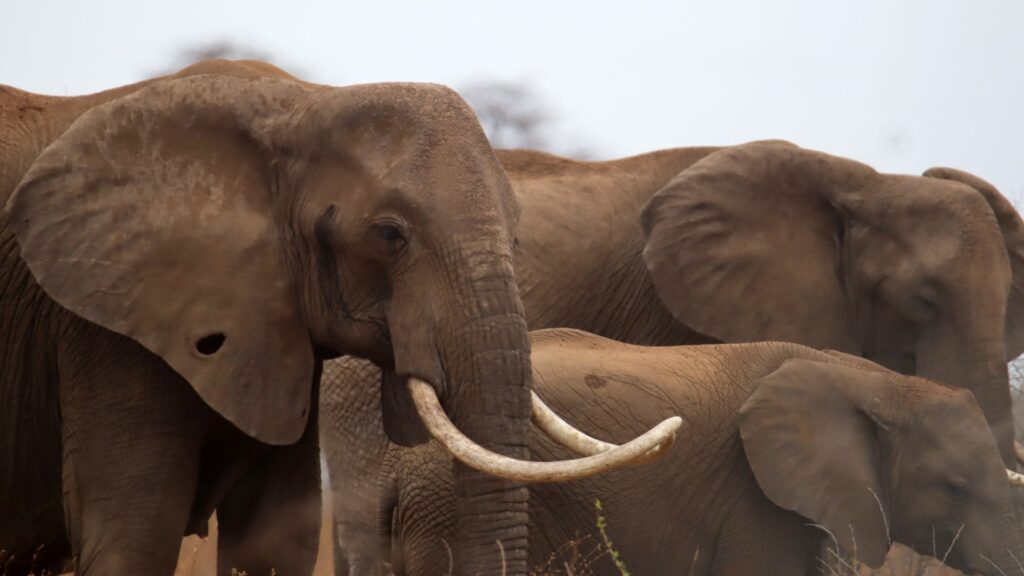
Buffel, the Grass family’s matriarch (pictured front).
We’re delighted to share some big news and introduce the Grass Family, one of the beloved elephant herds that roam the Meru landscape in Kenya. For nearly 10 months they had seemingly vanished into the wilderness, until they recently reappeared, and were spotted by our team.
As dry season takes hold in Meru, elephants must travel further to find water and sufficient food. This makes following families harder for our monitoring team and each sighting more significant.
Our Saving Meru’s Giants team are skilled in elephant monitoring, able to identify individual elephants and their families living in and around Meru National Park. Each elephant tells a story written in the unique patterns of their ears and tusks, like Shujaa, the lone bull elephant known by the team and community members in Meru by his distinctive one tusk.
The intimate knowledge we’ve gained by monitoring individuals allows us to better understand their complex social lives and how they live in one of Kenya’s wildest landscapes. When drought scorches Meru or the long rains cause an explosion in greenery, we can monitor how the elephants respond. When elephants move along ancient migratory routes, we often witness human-elephant conflict erupt, implicating some of our more infamous elephants.
With the knowledge of individual elephants, their lives, and family groupings, we shape our conservation initiatives to reduce human-elephant conflict, adapting to elephant movements and climatic conditions.

Bentley, a sub-adult male from the grass family, in September 2025
Irene Kanga, our Saving Meru’s Giants Monitoring Officer shares why the latest sighting of Grass family was particularly exciting for our monitoring team: “It had been nearly 10 months since the last confirmed sighting of the Grass family, one of Meru National Park’s most iconic elephant herds. Their reappearance this week was not just an ordinary event; it served as a powerful reminder of the resilience of these magnificent animals and the importance of protecting their habitat.
“Since the project began in 2021, the family has been spotted three times, with photos of only two individuals in the elephant database. In Meru’s bushy landscape, seeing elephants well enough to capture photos can be tricky. However, during this most recent sighting, we were able to photograph seven elephants and catalogue six new individuals.

Buffel and calf, pictured in February 2024
“This included the wise matriarch Buffel, who has led this family for years. Buffel is distinguishable by her ear markings – she has two holes on her right ear along with impressive tusks which converge across her trunk.”
Gathering as much information about the families and new calves is important as this provides vital insights into how the elephant population is doing.
“In the Grass family this time were two adult females, two playful calves, and two sub-adult males who stayed close to Buffel’s side.” Irene explains, “We observed them calmly grazing before they moved off in search of water. We headed towards the river, and upon reaching it, we saw them drinking and occasionally splashing it on themselves – signs of a relaxed and thriving herd.”
Witnessing the family all together at the height of the dry season is particularly significant. Dry conditions can place immense stress and strain on herds as dwindling water and scarce vegetation forces them to travel further in search of resources. In the dry season some herds will fragment into smaller groups to increase efficiency and reduce competition for resources.
“Meru National Park is a vital environment for elephants, with enough water and food to sustain them.” Irene continues, “It is critical that we can protect this landscape and moments like this strengthen our resolve to continue our efforts in elephant monitoring, anti-poaching patrols, and community awareness programs.”
Thanks to Irene for sharing this wonderful recount of the teams encounter with the Grass Family. Your support allows the team on the ground to monitor elephants and protect their Meru home.
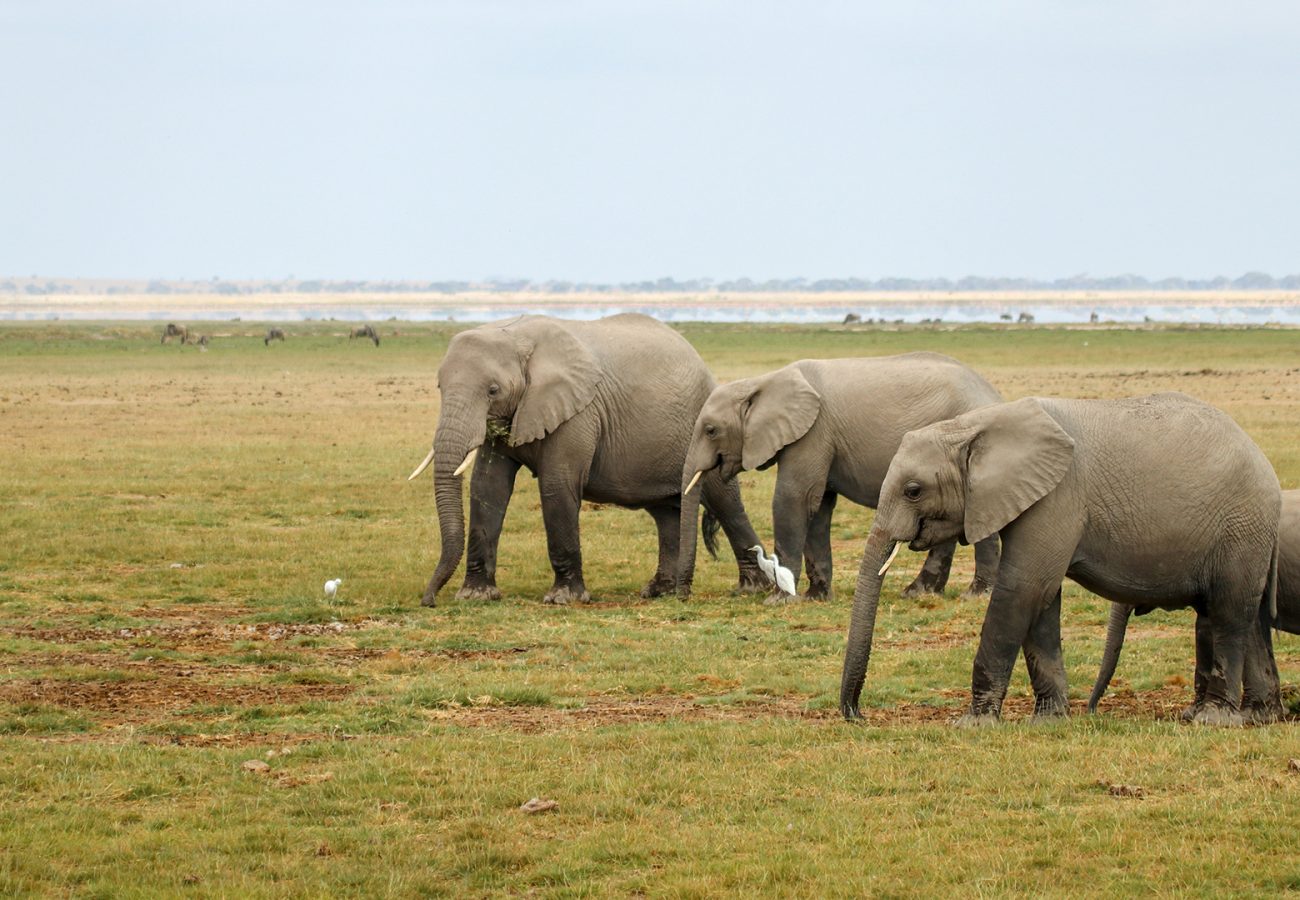
LOVE ELEPHANTS?
Adopt an elephant with Born Free today, to help protect wild African elephants from habitat loss, conflict, trophy hunting and the ivory trade.