
Born Free pressures international governments to step up for wild animals
Attending a technical meeting of the United Nations Convention on Biological Diversity in Panama, Born Free championed wild animal welfare as essential to restoring ecosystems and driving climate solutions.
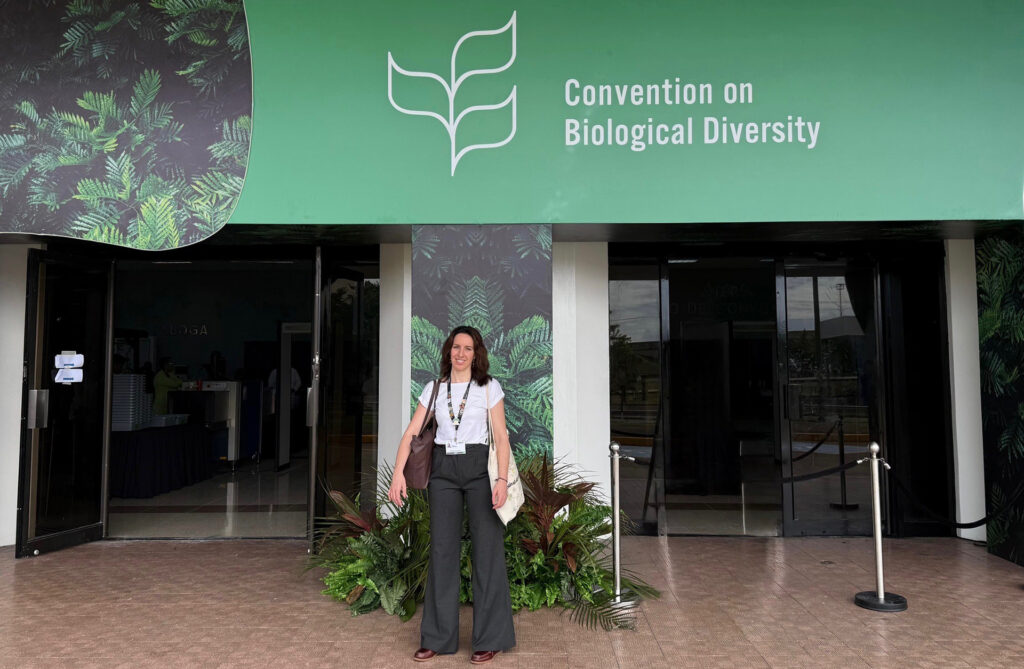
Adeline Lerambert at the CBD meeting in Panama
Born Free’s International Policy Manager Adeline Lerambert, who attended the meeting, explains more.
Why did this meeting matter for wildlife?
The 27th meeting of the Subsidiary Body on Scientific, Technical and Technological Advice (SBSTTA-27) of the United Nations Convention on Biological Diversity (CBD) convened at a pivotal moment for the planet, one year ahead of the 17th Conference of the Parties (COP17) and amid growing pressures on the international community to effectively address the nature crisis.
Taking place from 20-24 October in Panama, SBSTTA-27 focused on providing scientific and technical advice to guide governments’ progress in implementing the Kunming-Montreal Global Biodiversity Framework (KMGBF), the world’s roadmap for halting and reversing biodiversity loss by 2030. With its four goals and 23 targets, the KMGBF constitutes a critical beacon of hope for tackling the interconnected crises of biodiversity loss, climate change and pollution.
What is SBSTTA?
SBSTTA’s main role is to produce science-based recommendations that guide the Conference of the Parties (COP) in making informed decisions on biodiversity conservation.
Meetings of the SBSTTA represent an important preparatory step toward the COP, providing an opportunity for stocktaking, boosting momentum and ensuring that actions are grounded in the most relevant, up-to-date evidence.
How was Born Free involved in SBSTTA-27?
Born Free, together with the World Federation for Animals and other international partners, actively engaged policymakers in the lead-up to and at the meeting in Panama, pressing governments to ramp up protections for wildlife and habitats and to end all forms of exploitation. We championed wild animals as essential allies in restoring resilient ecosystems, driving climate solutions, and safeguarding public health.
On 21 October, Born Free co-hosted a side event at the meeting with the World Federation for Animals, the International Union for Conservation of Nature (IUCN), the Smithsonian Institute, the Inter-American Institute for Global Change Research (IAI) and several supportive governments.
We emphasised why addressing animal welfare concerns is key to achieving shared gains for biodiversity conservation, preventing zoonotic diseases, and strengthening the biodiversity-climate-health linkages. We also promoted the adoption of ‘positive lists’ as a national measure to tackle the health risks associated with the trade in and keeping of wild animals as pets, by limiting which species can be kept to those that can best adapt to captivity and pose the least risk.

Attendees of the animal welfare side event co-hosted by Born Free
Are countries’ efforts to protect wildlife and nature sufficient?
To date, only 55 of the 196 Parties to the Convention have updated their National Biodiversity Strategies and Action Plans (NBSAPs), detailing how they plan to achieve the global targets for nature recovery to which they are committed.
Implementation therefore remains uneven, despite reassurances by most delegates in Panama, particularly from developing countries, that the main barriers stem from financial and structural constraints rather than a lack of political will. With only five years to 2030, overcoming these limitations is essential if we are to secure a brighter future for wildlife and people.
Did SBSTTA-27 deliver any wins for wildlife?
Differences between countries over the CBD’s work priorities, the sources of information for the upcoming review of progress, and repeated calls to respect national circumstances, highlighted the challenges in reaching a consensus on advancing biodiversity goals. As a result, differences persist among governments on how to move forward.
However, Born Free was pleased to see most of our central asks for wildlife reflected in the final SBSTTA-27 recommendations on the following items:
Biodiversity and Health
In 2022, the Convention adopted the Global Action Plan on Biodiversity and Health (GAPBH), which, among other things, asks countries to address the root causes of zoonotic diseases (those that spread between animals and people).
This includes tighter rules on using and trading wild species, reducing conflicts between people and wildlife, and adopting a One Health approach, linking the health and wellbeing of people, animals, and ecosystems.
The delegates in Panama:
- Recognised the importance of implementing a One Health approach to support major changes that reduce harmful practices like wildlife exploitation and intensive farming.
- Encouraged closer cooperation between government departments, agencies and wider stakeholders responsible for biodiversity, human and animal health, and the wider environment, and welcoming the Pandemic Agreement adopted earlier this year by the World Health Assembly.
- Agreed to keep developing science-based indicators and tools to measure progress on biodiversity and health, with input from wider stakeholders including Born Free.
Born Free also had positive discussions with several Parties about the development of national One Health strategies that integrate our priorities for wildlife, such as ending high-risk wildlife practices and preventing diseases from emerging at their source, which is the best way to stop future pandemics.
Biodiversity and Climate
Delegates reaffirmed that biodiversity loss, climate change, desertification, and degradation of land and oceans are interconnected crises that demand coordinated, science-based solutions.
Notable positive developments were:
- Strong support for increasing cooperation among the global bodies responsible for nature, climate and the wider environment (often referred to as the ‘Rio Conventions’).
- Consensus on the need to prioritise the protection and restoration of carbon-rich, high-ecological-value ecosystems as essential for both biodiversity recovery and climate resilience.
- Agreement to improve policy alignment and share technical expertise, although calls to respect the boundaries of each Convention’s mandate were also heard.
- Born Free continued to stress that healthy wildlife populations are vital to ecosystem function and climate stability and must be central to efforts linking biodiversity and climate action.
What’s next? Toward CBD COP17 and beyond
In her concluding statement, Astrid Schomaker, the CBD’s Executive Secretary, emphasised:
“Our work for nature and people, their wellbeing and prosperity will continue, must continue and must accelerate, so let’s get to it. […] We owe it to the world to make these meetings stepping stones to global action to preserve and restore our world’s biodiversity in Yerevan”.
Born Free remains steadfast in amplifying the voice for wildlife within the Convention on Biological Diversity and beyond, promoting holistic and compassionate solutions to today’s complex, connected challenges.
Our Policy team will continue this mission at the upcoming COP20 of the Convention on International Trade in Endangered Species (CITES) in Uzbekistan, where we will advocate for stronger protections for threatened wild animals in trade. This will be followed by COP15 of the Convention on the Conservation of Migratory Species (CMS) in Brazil in March, where we will push for greater safeguards for migratory wildlife.
Negotiations under the Convention on Biological Diversity will resume with SBSTTA-28 in July 2026 in Nairobi, Kenya, and will culminate at COP17 in Yerevan, Armenia in October 2026.