
36 Amazing Monkey Facts
Discover 36 incredible monkey facts, from record-breaking howls to tail tricks and clever tool use.
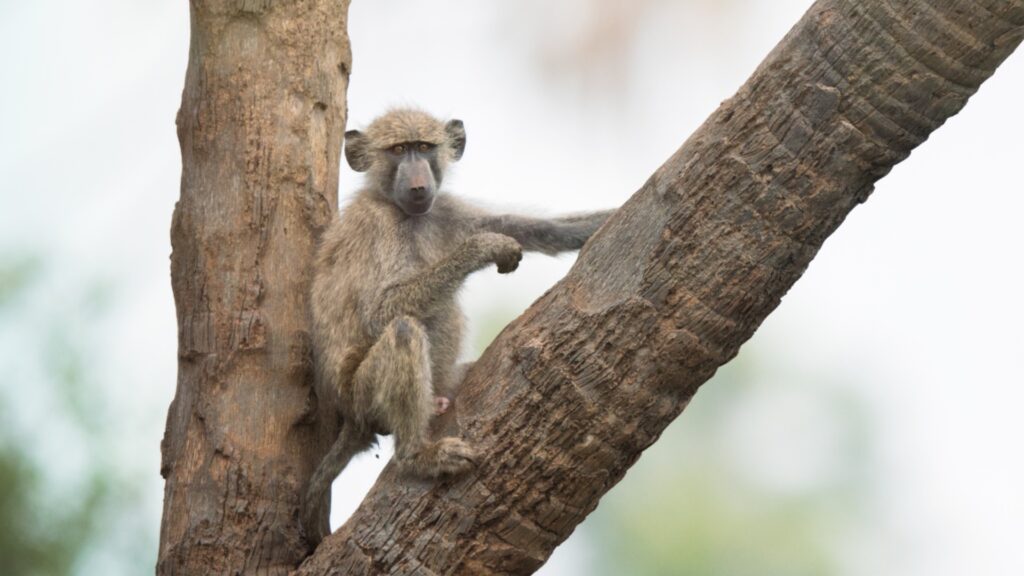
A wild baboon in Kenya (c) georgelogan.co.uk
Monkey Facts: 36 Amazing Things You Didn’t Know About Monkeys
Our monkey fact file has everything you need to know about these marvellous mammals. Living in the mountains of Morocco, the jungles of Cameroon and the cities of India, these fun monkey facts cover it all!
1. Monkeys are primates, just like apes and humans
Monkeys are closely related to humans and apes, though they are a separate group. Check out our primate facts to discover more about primates.
2. Every monkey has a tail – even if it’s tiny
Unlike apes, all monkeys have tails. Some are short stubs, such as Barbary macaques, found in Northern Africa and Southern Europe, that are barely noticeable, while others, such as woolly monkeys, have long and prehensile tails.
3. There are over 200 species of monkey in the world
These range from pygmy marmosets to large baboons, living across Africa, Asia, and the Americas.
4. Monkeys are split into two major groups: New World and Old World monkeys
Monkeys found in the Americas are in the group Neotropical primates, or ‘New World’ monkeys. These species have been classed as ‘platyrrhines’ , which means ‘flat nose’, as many have a flattened muzzle and broadened nostrils. Species living in Africa and Asia are often referred to as ‘Old World’ monkeys, as Europeans classed the Americas as a ‘New World’ when they first arrived there. Old World monkeys are ‘catarrhine’ monkeys.
5. Some monkeys have prehensile tails
Many species of Neotropical monkeys, like spider monkeys, found in Central and South America, can use their strong prehensile tails as an extra limb, using them to grasp branches.
6. The term “monkey” isn’t a scientific category
It’s a general term to describe a group of species. Despite sharing similarities, apes are not monkeys as they lack a tail, have larger brains and are generally larger in body size than monkeys.
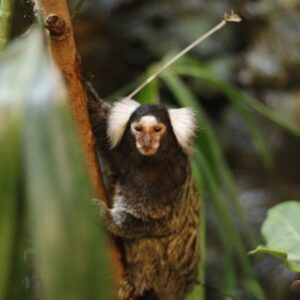
Marmoset (c) Ted Johnsson, Unsplash
7. The world’s smallest monkeys are the pygmy marmosets
There are two species of these tiny monkeys living in the Amazon Basin in South America; the eastern pygmy marmoset and the northern pygmy marmoset. Due to their small size, they are sometimes called ‘finger monkeys’ and marketed as pets, but pygmy marmosets do not make good pets. They are wild animals, whose welfare needs cannot be met when kept as a pet.
8. The largest monkey is the mandrill
Male mandrills are the biggest monkey. They can weigh over 30kg and live in the rainforests of central west Africa. Female mandrills are much smaller than males, and weigh less than 10kgs.
9. Howler monkeys are one of the loudest land animals
Aptly named, howler monkeys do exactly as their name says. Their howl can travel far through the dense forests of Central and South America, and a group of howler monkeys will often come together to howl, creating an impressively loud roar.
10. Macaques in Asia know how to bargain
In Indonesia, long-tailed macaques have learned barter with tourists. The macaques regularly steal items from people and appear to understand which items are valuable. They’ll trade these stolen sunglasses or phones back to humans in return for food, with high-value items requiring more food items than lower-value items.
While such behaviour indicates how intelligent and adaptable these animals are and may appear ‘funny’ or ‘cute’, these kinds of close interactions can quickly escalate into conflict situations, with bad outcomes for both macaques and people, which is why Born Free urges tourists not to seek direct contact or close interactions with wild animals.
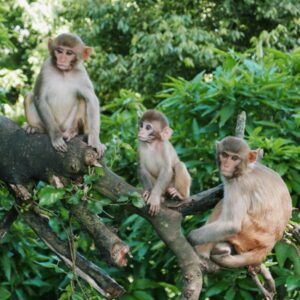
(c) Falco Negenman on Unsplash
11. Monkeys are highly social and live in groups
Most species of monkeys are very social, living in pair-bonds or groups. Some groups range from hundreds of individuals, while others may be small family groups. South American monkeys such as Titi or owl monkeys form strong, long-lasting pair-bonds. Other species such as Mantled Howler monkey males, in Central and South America, will spend time as solitary individuals as they look for a new group to join.
12. Many species have dominance hierarchies
These dominance hierarchies can be strict and determined at birth. In chacma baboons, found in southern Africa, the social rank a female is born into will usually remain her rank for life, while males fight for their rank and it will vary across their life. Social rank affects grooming rights, food access, and mating opportunities.
13. Grooming is a vital social activity
Grooming is a behaviour seen in many animals and is particular important for many monkey species. Grooming is often thought to be about keeping clean, but it is also vital for building bonds between individuals and reducing stress.
14. Capuchins are expert tool users
Capuchin monkeys, found across Central and South America, were the first monkeys found to be using tools. Bearded capuchins use stones to crack nuts and sticks to fish for insects. They even select the stone they will use depending on the nut they want to crack!
15. Some monkeys have cheek pouches to store food
When feeding, some species can fill their cheek pouches with food. This can help them gather food quickly, which they can then eat later when it is safe. Only some Old World monkeys have cheek pouches, while New World monkeys don’t.
16. Japanese macaques bathe in hot springs to stay warm
Also known as snow monkeys, they’ve been observed soaking in warm pools in freezing weather. Japanese macaques regularly feature in nature documentaries for this unusual behaviour.
17. Diana monkeys have alarm calls that differ depending on the threat
Alarm calls are used to alert group members to a threat and Diana monkeys, found in West Africa, have specific alarm call for leopards and another for eagles.
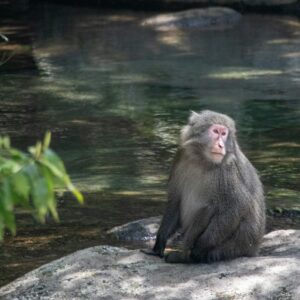
Photo by Roman Davydko on Unsplash
18. Many monkeys can swim
Proboscis monkeys and rhesus macaques, both found in Asia, are strong swimmers, often crossing rivers in the wild.
19. Monkeys have forward-facing eyes and stereoscopic vision
Like people, monkeys’ eyes face forward, and their stereoscopic vision (3D) helps them judge distances.
20. Their hands and feet are highly dexterous
How monkeys can use their hands and feet will vary among species but generally, they can grasp, grip, and manipulate objects with great skill.
21. Monkeys typically walk on all fours
But, some can walk short distances on two legs when needed. Walking primarily upright (bipedal) is a unique human trait.
22. Owl monkeys are the only nocturnal monkeys
Also called Night monkeys, they are active after dark. Living in the forests of South America, owl monkeys have large eyes and specially adapted to their nocturnal lifestyle.
23. Monkeys use a wide range of facial expressions
Facial expressions are used to convey mood, aggression, playfulness, and more. Sometimes, a monkey grimacing is described as them smiling, but a grimace can be a sign of stress or anger, and a monkey baring its teeth is usually not happy.
24. Most monkeys eat plants – but not only plants!
They enjoy fruit, flowers, seeds, and leaves, but some also eat insects, eggs, and small animals.
25. Golden snub-nosed monkeys live in freezing mountain forests
They’ve adapted to harsh, snowy environments in China, living between 1,800 – 2,400m. Lichens and leaves form a big part of their diet.
26. Capuchins live long lives for their size
They can survive live for over 53 years in the wild. Like humans, capuchins have slow life-histories. This means that they develop slowly and aren’t mature and ready to reproduce for a number of years (6 years old for females and 10 years old males).
27. Kipunji’s were only identified in 2005 by scientists
One of the newest monkey species ‘discovered’ by scientists is the Kipjunji in Tanzania. They are closely related to baboons and initially, scientists weren’t sure which genus it would belong too, and in fact – this species is its own genus!
28. Male mandrills display bright colours to attract mates
Mandrills’ distinctive red facial markings’ vividness is related to rank and testosterone levels. A male’s face colour will vary as they rise up or drop ranks. Female mandrills also have distinctive colours, but their colouration varies less with rank or health and is linked to age and whether they have had multiple offspring or not.
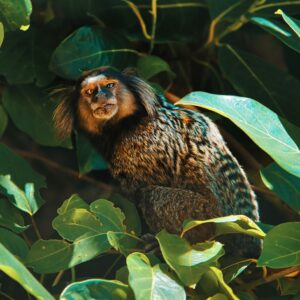
(c) Krys Amon on Unsplash
29. Most species give birth to a single baby
Marmosets and tamarins are the exception – both New World monkeys – giving birth to twins more commonly. Northern pygmy marmoset females give birth to twins twice a year, and the adult male and other group members will help the female carry the infants.
30. Baby monkeys rely on their parents for care
Many monkey species develop slowly, clinging to their mothers or carers for transport.
31. Some monkeys show empathy and cooperation
Like humans, many monkeys are highly social and show emotion associated with this. They can console distressed group members and share food. Golden lion tamarins, found in Brazil, have even been seen to share food between different social groups, not just within.
32. Monkeys are excellent seed dispersers
As they eat fruit, they will consume the seeds and then these are dispersed through their environment when they defecate. Their diet helps spread plant life and is vital for maintaining habitats.
33. They’re found in every type of habitat
From tropical rainforests to savannahs, deserts, and mountain peaks. Some species are adapted to living in specific environments, such as high-altitude living Geladas who roam the plateaus of Ethiopia’s highlands. Born Free is dedicated to providing a safe home for rescued geladas in at Enessa Kotteh.
34. Monkeys are under serious threat from humans
Like much of the world’s wildlife, many monkey species are threatened with extinction as a result of human activities. Deforestation, illegal pet trade, and hunting are all reducing wild populations.
35. 15 out of the 25 most threatened primates in the world are monkeys
Every few years, the IUCN Primate Specialist Group compiles a list of the world’s most threatened primates. In the 2023-2025 report, fifteen species of monkey were listed, including Golden-bellied Mangabeys, found only in the Democratic Republic of Congo, Cat Ba Langur from Vietnam and Olalla Brothers’ Titi, endemic to Bolivia.
36. Monkeys don’t make good pets
No matter how cute they may be, monkeys aren’t suitable pets. They have complex needs which can’t be met in captivity, especially in a house. They deserve to be free in the wild, living in their natural habitat.
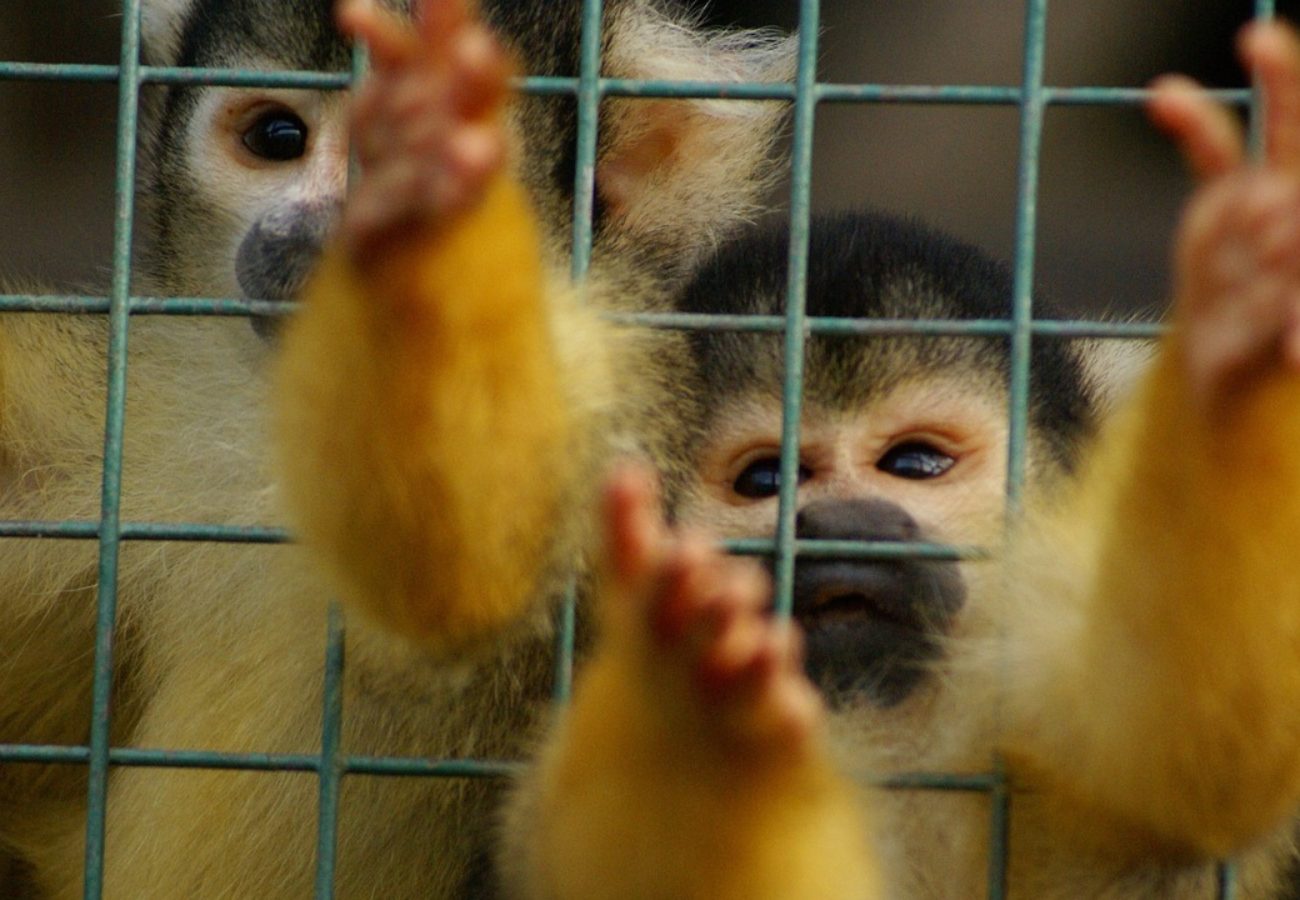
help us end the exploitation of monkeys for entertainment
We need you to Raise the Red Flag, and report the suffering of animals in captivity, so that we can take action to make it end.