
30 Facts About Hyenas
Discover 30 fascinating facts about hyenas, from their matriarchal clans to their bone-crushing bite. Find out why these misunderstood animals need our help.
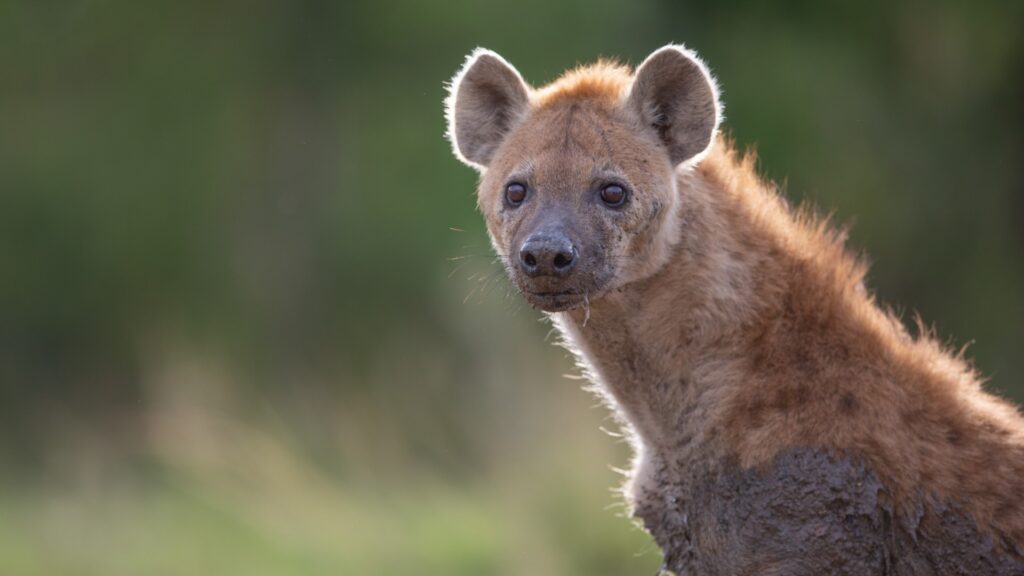
(c) www.georgelogan.co.uk
When you think of hyenas, the outlands from The Lion King often comes to mind, but these fascinating carnivores are so much more than their Disney image.
Hyenas play a vital ecological role and possess remarkably complex family structures, qualities that have long gone unrecognised and undervalued. Keep reading to find out more about hyena biology, behaviour and conservation status.
1. There are four species of hyena
There are four living members of the Hyaenidae family, each is unique with distinct behaviours and social structure. Made up of spotted, striped and brown hyenas, and the insectivorous (insect-eating) aardwolf, this family is spread across Africa, with striped hyenas also found in Asia, extending as far as India.
2. Hyenas are more closely related to cats than dogs
Despite looking more like dogs, hyenas are more closely related to cats. But they aren’t part of the cat family, they are a unique family – the Hyaenidae. This family is more closely related to genets and mongooses than cats.
3. Hyenas have very powerful bites, able to even break large bones
Researchers believe that there are only three groups of carnivorous mammals who have been able to break open large bones. The Hyaenidae family is the only group with living members, while the other two groups are both extinct.
Being able to break bones allows hyenas to access the marrow within and gain minerals. This skill also plays an important role in recycling nutrients, such as calcium and phosphorous, which would otherwise remain trapped inside bones.
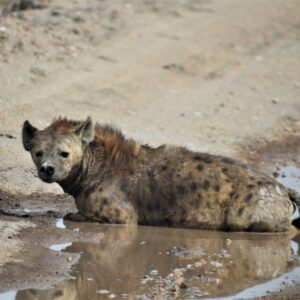
4. Spotted hyenas are Africa’s most common large predator
(c) Born Free
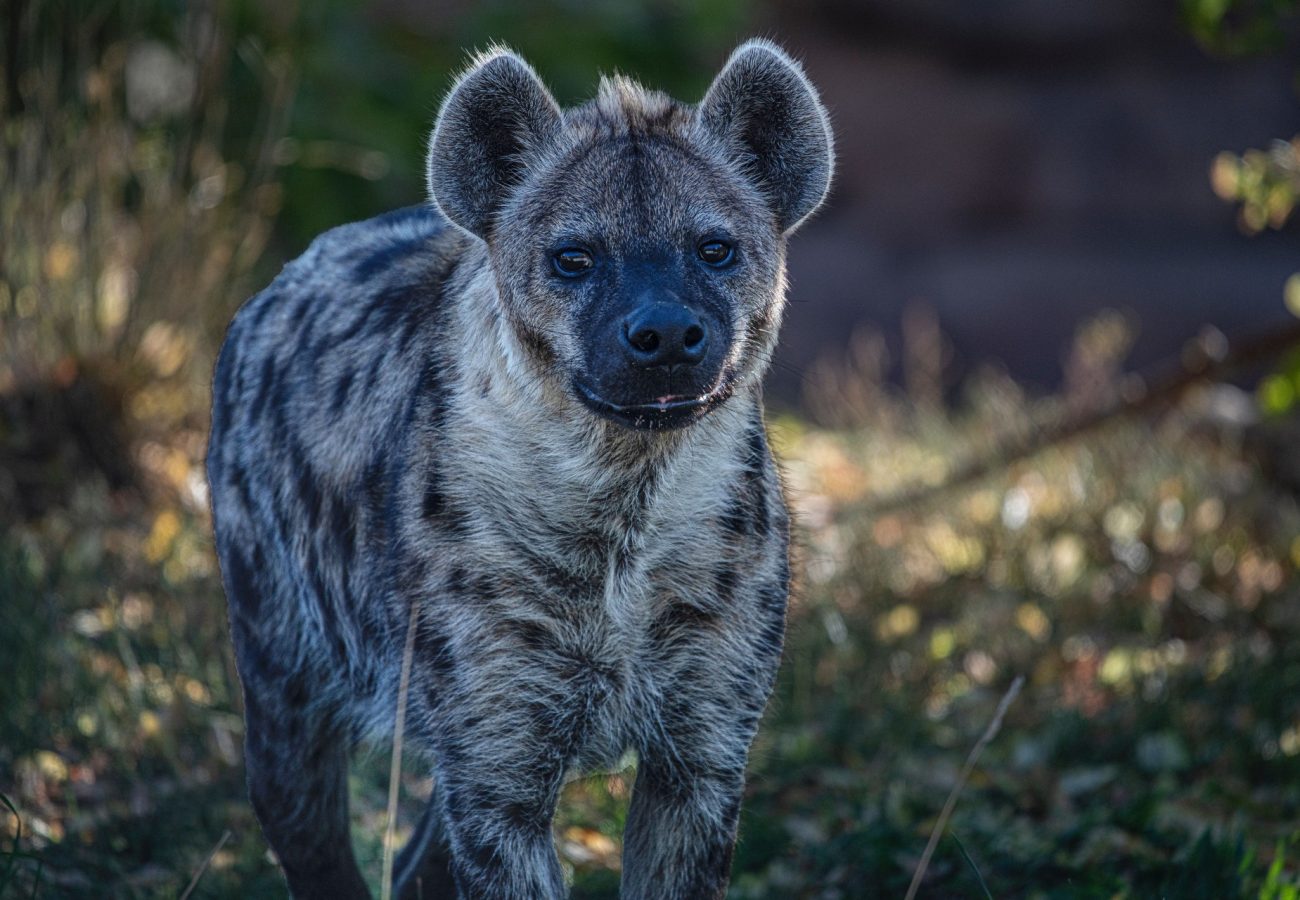
Often considered purely scavengers, spotted hyenas break the stereotype and are very capable hunters. They have adapted to hunt medium-large ungulates (hoofed mammals), taking a role in the food chain as an apex predator. The total population of spotted hyenas remains uncertain, but estimates suggest there are between 27,000 – 47,000 individuals across sub-Saharan Africa.
5. Striped and brown hyenas are two of the world’s largest scavengers
As a member of nature’s clean-up crew, brown and striped hyenas play a vital role in removing carcasses and clearing carrion (the decaying flesh of dead animals) from ecosystems, recycling these nutrients. As scavengers, their diet is wide ranging, including animal parts, plants and soils.
6. Hyenas live in 66 countries
Spread across Africa and much of Asia, the four species occupy a wide variety of environments and habitats. Striped hyenas are the most widespread, found in 40 countries across the two continents, with spotted hyenas not far behind, living in 39 African countries. Brown hyenas’ range is considerably restricted compared to their relatives, only living in five southern African countries, while aardwolves are found in 15 countries in Africa.
7. Aardwolves are one of the few living mammals which feed exclusively on termites
Despite being a member of the Hyaenidae family, aardwolves almost solely eat termites and unlike other animals whose diet is dominated by termites, they don’t have special adaptations, such as long-sticking tongues, like pangolins.
Like their hyena relatives, aardwolves have large canine teeth, but they lack developed molars, meaning even if they did kill larger prey, they would be unable to eat it.
8. Spotted hyenas are one of the most social carnivores
Spotted hyenas have a very distinctive social system – often thought to be more like some primates than that of other carnivores. They live in groups called ‘clans’ which can have as many as 80 members. The clans function as large, stable families with multiple generations living alongside each other.
9. The spotted hyena’s laugh is a powerful communication tool
While a spotted hyenas ‘laugh’ or ‘giggle’ is often thought of as an eerie, spooky sound, it is an important method of communication. Scientists believe a spotted hyenas laugh could include information about an individual’s identity, rank and age, giving the receiver a cue to assess the social position of the ‘laughing’ individual.
Alongside their iconic laugh, spotted hyenas have a wide range of vocalisations, including a ‘whoop’ which is thought to be used to transfer information to individuals over 3 miles (5km) away.
10. Spotted hyena society is matriarchal

(c) www.georgelogan.co.uk
At the centre of spotted hyena society is a female-led hierarchy: daughters inherit social rank directly from their mothers, and this status can shape access to food, allies, and reproductive success throughout their lives. Females are more aggressive than males, with adult females and her cubs dominant over adult males.
11. Female spotted hyenas are larger than males
While elsewhere in the animal kingdom, females are often larger than males, this is rare among mammals. Spotted hyena females are generally larger than males, a trait known as ‘female-based sexual dimorphism’.
12. Aardwolves are the smallest member of the Hyaenidae family
Both male and female aardwolves weigh around only 10kg, making them by far the smallest living member of the family. In comparison, spotted hyenas can weigh up to 90kg. Striped and brown hyenas are around 30-35kgs and 40kgs respectively.
13. All four species use latrines
Latrines are a specific, communal area, where hyenas will regularly defecate (poo). These latrines play an important role in marking territory, communicating with clan members and other species.
Striped, brown and spotted hyena poo is easily recognised by its white colour, a result of high calcium content in their diets.
14. Spotted hyenas are exceptional long-distance runners
Spotted hyenas are pursuit predators, which means they chase their prey and use their endurance as a hunting method. They can even reach speeds of up to 50-60 km/h (30-37mph). This differs from lions and leopards who are ambush predators, relying on the element of surprise to catch their prey.
15. Spotted hyenas can travel far each night
One study in the Maasi Mara, Kenya found the average distance travelled by spotted hyenas in a 24-hour period was 12.4km, while some nights, this was as nearly 22km. In the Kalahari however, the average nightly distance was double the distance of the Mara hyenas, with individuals traveling on average 27km a night. Prey availability and territory size will influence how far spotted hyenas need to travel each night in search of food.
16. Brown hyenas and spotted hyenas rarely overlap
Across much of their range, spotted hyenas and brown hyenas are not found in the same areas, but in Central Tuli, Botswana, their home ranges do overlap. Researchers have examined how these species interact by studying shared latrine sites. The shyer brown hyena tends to avoid spotted hyenas.
17. Brown hyenas are sometimes called ‘strandwolves’
‘Strand wolf’ comes from their Afrikaans name which translates as ‘beach wolf’. Brown hyenas prefer dry areas, such as semi-desert, open scrub and coastlines. Whilst primarily scavengers, populations living along the Namib Desert Coast are successful hunters of Cape Fur seals.
18. Hyenas are crucial for ecosystem health
Hyenas live in a diverse range of habitats and play an important role in maintaining healthy ecosystems. By scavenging and hunting, they recycle nutrients and minerals, clean-up carcasses and may even remove diseases from the food chain. Without spotted, brown and striped hyenas acting as clean-up crew, both natural and human-generated waste may not be recycled.
19. All four species use dens
Dens offer a safe place to sleep and raise cubs, where they can be protected from predators. Spotted hyenas have communal dens, where clans come together and cubs will be raised in a creche, once they are a few weeks old.
Dens are a long-term resource – striped hyenas in Israel used dens for an average of two years, with some remaining resident in a den for as long as eight years. Aardwolves spend considerably more time in their den in winter, when fewer termites are available.
20. Brown hyenas are a secretive, elusive species
Brown hyenas are particularly difficult to study, with much yet to be discovered about their lifestyle. As primarily scavengers, brown hyenas will eat a wide range of vertebrate remains, but they will also forage on wild fruit, insects and eggs.
21. Spotted hyenas’ jaws are not fully developed until they are five years old
Spotted hyena bite-strength continues to develop until they are around five years old, meaning that when they are weaned in the wild, at around 12 months old, they will still not be able to access all the same food as adults.
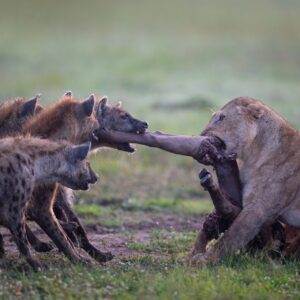
22. Hyenas and lions are fierce competitors
(c) www.georgelogan.co.uk
Spotted hyenas will sometimes steal kills from lions and vice versa, in what is called ‘kleptoparasitism’. This is a foraging strategy, where one species will intentionally steal the food of another species. Between lions and spotted hyenas, this can take away the work of having to have a successful kill. Leopard kills are also targeted by spotted hyenas, and this is one of the reasons leopards will drag their kills into trees, protecting it from hyenas and other predators.
23. Aardwolves are socially monogamous
Aardwolves live in socially monogamous pairs – this means that males and females will form long-term bonds and share and defend a territory. While pairs maintain a close relationship, they will forage separately.
24. Brown hyenas will bring food to cubs of their relatives
Brown hyena cubs are raised in a den, where they can hide from predators. Once cubs are ready to eat solid food, both male and female clan members, who are not the parents, will bring food to the den to help feed the cubs. Female brown hyenas will bring food to even distant relatives, while males will support their siblings, but weren’t found to provide for their cousins.
25. Striped hyenas were previously thought to be solitary
Striped hyenas are usually seen alone, leading researchers to believe they were solitary, but later research has suggested they may be more social than was previously thought. Camera trap studies found that striped hyenas appeared to ‘intentionally’ meet and commonly used the same spaces, suggesting they may have complex social structures that we are yet to fully understand.
26. They are widely persecuted by humans
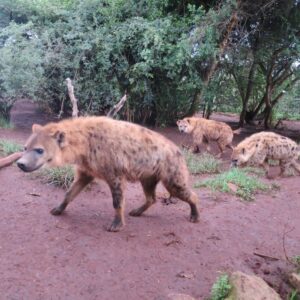
Hyenas (including Tigeste) at Ensessa Kotteh
Across their range, spotted, striped and brown hyenas are killed by people, in retaliation for livestock predation, out of fear, or even for use in traditional medicine. A poisoned carcass can easily take out an entire hyena family, whether hyenas were the intended target or not.
Born Free’s Ensessa Kotteh sanctuary in Ethiopia is home to six spotted hyenas, some of whom were rescued following the killing of their mother or from traffickers. Tigeste, a spotted hyena, who now lives happily at the sanctuary was rescued from appalling conditions in a zoo, where she was restricted to a barren cage.
27. Striped and brown hyenas are listed as ‘Near Threatened’
Both these species are categorised as ‘Near Threatened’ on the IUCN Red List as there are less than 10,000 mature individuals. Populations of both species are expected to decline in the next three generations without intervention.
Spotted hyenas are classed as ‘Least Concern’ but their populations are declining, especially outside of protected areas. A classification of ‘Least Concern’ does not necessarily mean a species if safe, it means they are not at immediate risk of extinction, but populations can continue to decline. Aardwolves are also considered ‘Least Concern’ but their population remains stable, without significant declines.
28. Hyenas’ reputation can make conservation more challenging
Hyenas’ reputation as sinister or dirty animals reduces public sympathy and can make their conservation difficult. Change is possible, however. Aardwolves were previously persecuted by farmers but following education and outreach work, many famers now actively conserve aardwolves.
29. Hyenas are often the victims of indiscriminate snaring
Snares do not discriminate which animals are caught in them, with many non-target species killed in snares each year. All four species of hyena are no different, and snares set across their range will injure and kill hyenas every year.
Born Free’s Twiga Team patrol Meru National Park, removing snares, which are set to catch wildlife, preventing both spotted and striped hyenas becoming trapped in these painful devices.
30. Born Free works to protect hyenas and their habitat
In Kenya, Born Free’s heartland, spotted and striped hyenas roam both the Meru and Amboseli landscapes. We work closely with communities to deter hyenas from predating on livestock, by supporting communities to build predator proof bomas and install predator deterrent lights. In doing this, we prevent retaliatory killings, protecting hyenas.
Hyenas need our help
Hyenas are not often the star of the show, but they play a vital role in ensuring healthy ecosystems and they need our help.
These species need people willing to advocate for them, and without effective conservation, changing attitudes and protecting their habitats, hyena populations will decline.
Desperate to know more about these wonderful carnivores? Find out more below:
HELPING HYENAS
Born Free is committed to community-led conservation and providing life-time care for rescued hyenas and your support ensures this is possible. Will you help us continue to protect hyenas?