
27 fun & interesting bonobo facts
Discover 27 interesting facts about bonobos – perfect for kids and animal lovers. Learn where bonobos live, what they eat, and why they need our help.
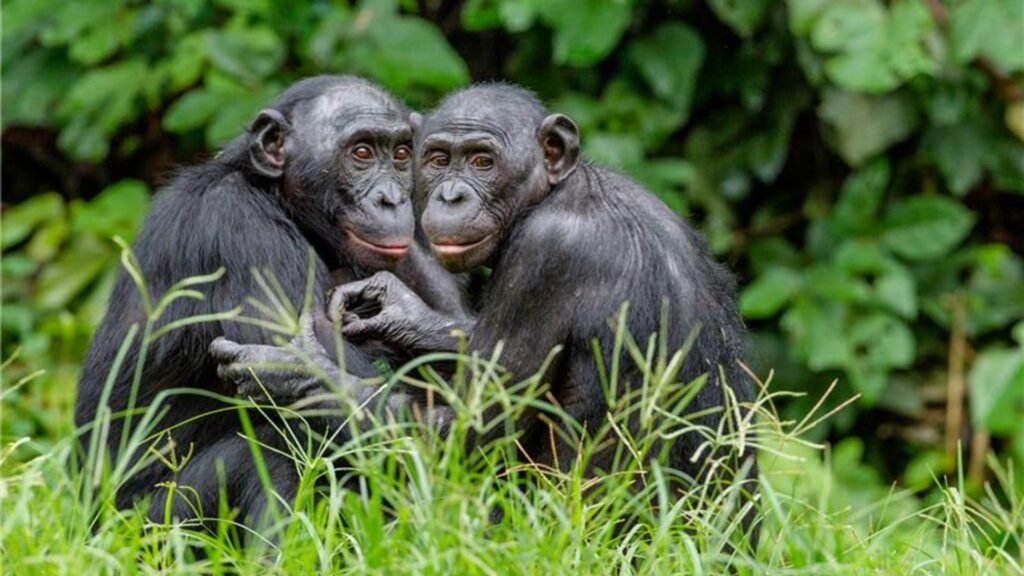
Wild bonobos (c) USO
27 Interesting Bonobo Facts You Need to Know
The lesser-known of the great apes, bonobos live in the jungles of the Democratic Republic of Congo. One of our closest living relatives, these intelligent, empathetic great apes are sometimes mistaken for chimpanzees. Find out everything you need to know about bonobos below.
1. Bonobos are great apes, not monkeys
Just like chimpanzees, gorillas, orangutans and humans, bonobos are great apes, in the Hominidae family. Great apes don’t have a tail, unlike monkeys and are considered the most intelligent primates.
2. They share up to 98.7% of our DNA
Bonobos are one of our two closest living relatives, along with chimpanzees.
3. Bonobos were once mistaken for chimpanzees
It wasn’t until 1929 that scientists recognised bonobos as their own species. Before this, given their smaller size and similar appearance to chimpanzees, bonobos were called pygmy chimpanzees.
4. Bonobos and chimpanzees evolved from the same common ancestor
Bonobos and chimpanzees are both in the Pan genus. They shared a common ancestor and separated over one million years ago.
5. Bonobos and chimpanzees are often still confused with each other
There are different ways to tell these two great apes apart. Bonobos are smaller than chimpanzees and have black ears, unlike chimpanzees. Infant bonobos also have black faces, with some pink pigmentation while infant chimpanzees usually have light-coloured faces, ears, hands and feet.
6. They live only in one place on Earth
Wild bonobos are found only in the rainforests south of the Congo River in the Democratic Republic of Congo (DRC). They are considered Endangered by the IUCN and populations have declined significantly in the last 20 years.
7. The population of bonobos in the wild is unknown
Only 30% of bonobos historic range has been surveyed by scientists, leaving the current population of wild bonobos unknown. From research done in four known bonobo populations, the IUCN estimated in 2016 there may be at least 15,000 – 20,000 individuals but populations are declining rapidly.
8. Bonobos and chimpanzees are separated by the Congo river
Bonobos are only found south of the Congo River, while chimpanzees are found north the river. Scientists believe the common shared ancestor lived north of the Congo river, but when water levels dropped for a brief period, some groups were able to cross over a million years ago. Chimpanzees and bonobos then evolved separately, developing differently socially and physically.
9. Bonobo societies are female-led
Bonobos live in matriarchal groups. This means that the dominant individual in the group is a female. This is different to chimpanzees and gorillas, where the dominant individual is usually a male. The social positions of females in the group are influenced by her ability to make and maintain social bonds with other females.
10. Bonobo males stay close to their mothers
Bonobo males remain physically and socially close to their mothers their whole lives. Mothers will support their sons in conflict, particularly against other males. Males will also form strong bonds with other females in the group.
11. Females migrate from their natal (birth) group
Female bonobos will migrate from their natal (birth) group between the ages of 6-10 years old. Moving into a new group isn’t too difficult as bonobos are welcoming to incomers. In their new group, the immigrant female will form strong social bonds with both females and males.
12. They’re known for being peaceful
Bonobos are more socially orientated and tolerant compared to chimpanzees. They are curious towards strangers to the group and will welcome new members. Living in forests with widely available, rich food, may have led bonobos to be less aggressive as they do no need to compete over food to the same extent some chimpanzee groups do.
13. Bonobos are incredibly empathetic
Empathy is being able to recognise and respond to the emotions of others and is particularly important for creating and keeping long-term social bonds. Bonobos show empathy towards other individuals and will react to the emotions of others, help each other and share food.
14. They’re highly intelligent
Bonobos can learn, reason and work together as a team to solve problems. Their social dynamic and tolerance of each other helps their teamwork be effective. They will also change their vocalisations dependent on the audience.
15. They live in multi-female, multi-male communities
Bonobo groups are usually made up of 30-80 individuals. They live in fission-fusion societies, which means that they will come together as a big group at times, while at other periods, split into smaller, changeable groups.
16. Bonobos have a unique way of using physical touch
Bonobos use behaviours such as hugging and touching to reduce tension, build friendships and encourage cooperation. They use this instead of fighting to help calm tense social situation.
17. Bonobo community ranges will overlap
Unlike chimpanzees, who are highly territorial, bonobo home ranges will overlap with each other. Home ranges are usually 20-60km2.
18. Female bonobos give birth every 4-5 years
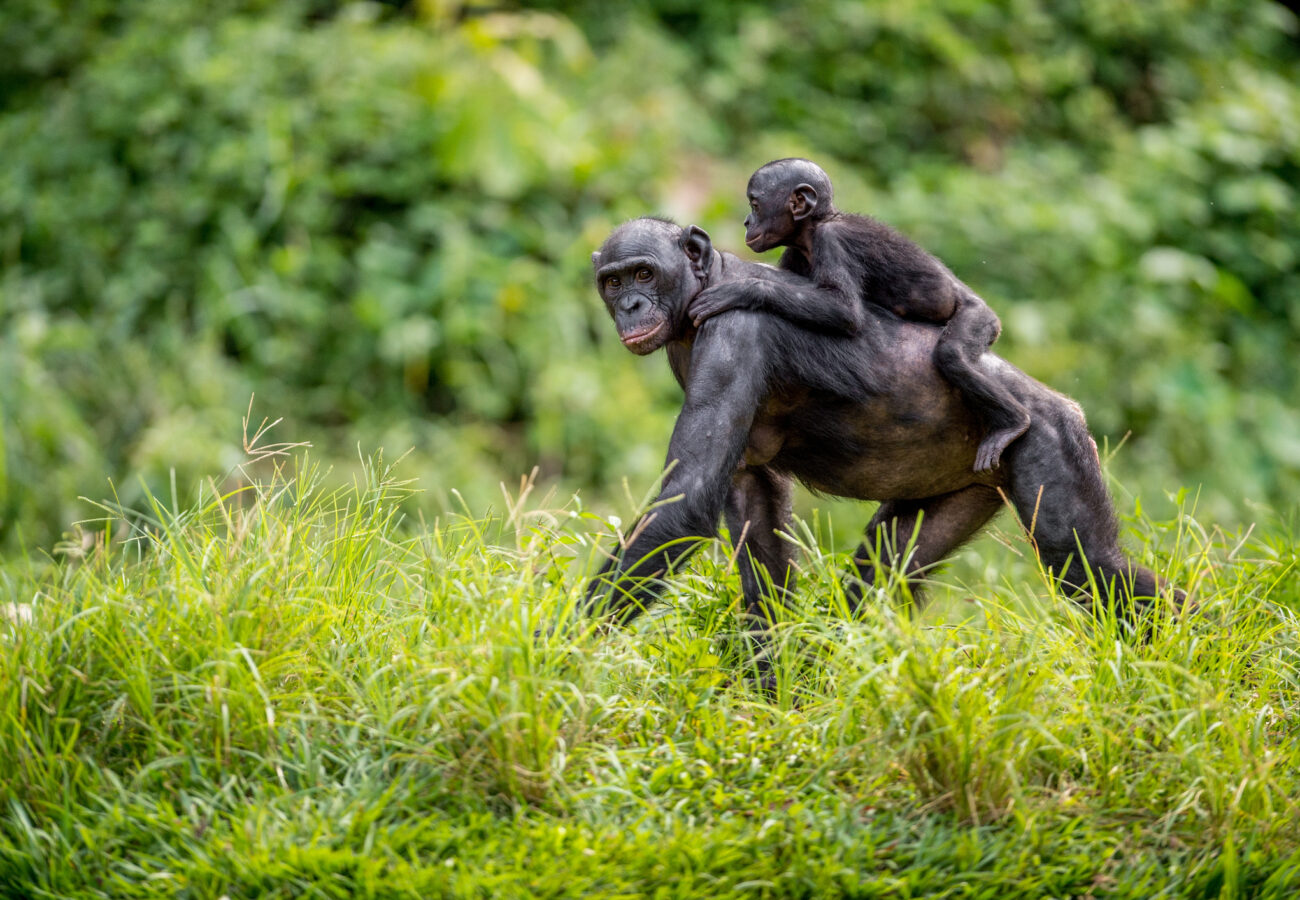
Like other non-human great apes, bonobos have a long period between births (the ‘interbirth interval’). Infants develop slowly and are usually weaned just before the birth of their sibling.
19. Bonobos are essential seed dispersers
When bonobos eat fruit, they will disperse the seeds throughout the forest when they defecate. This helps new trees grow and is critical for forest regeneration.
20. They’re omnivorous
Bonobos diet is wide ranging. Over 50% of their diet is fruit and seeds, with other foods such as leaves, stems, bark, flowers, honey and meat making up the rest.
21. They communicate with gestures and expressions
Bonobos use body language, facial expressions, and vocalisations to communicate with each other. They will change their vocalisations and gestures dependent on who they are communicating with.
22. They can walk upright
Bonobos are usually quadrupedal (moving on all fours) but they can be seen being bipedally (moving on only their feet).
23. Bonobos make nest each night
They build leafy nests to sleep in each night and sometimes, will also make day nests to rest in. These rests are usually in trees, but bonobos will occasionally also make nests on the ground.
24. They’re endangered and need our help
Bonobos are listed as Endangered by the IUCN. The biggest threats to wild populations are hunting, habit loss and fragmentation. Habitat loss is likely to increase as industrial agriculture expands into their habitat.
25. The bushmeat trade is the biggest threat faced by bonobos today
Despite it being illegal to hunt and consume great apes in the Democratic Republic of Congo, poaching is a serious threat to bonobo populations. When their family is killed, infant bonobos are often taken as pets. Luckily, there are organisations such as Friends of Bonobos, who were awarded Born Free’s Mackenna-Travers Award in 2021, who do incredible work caring for and rehabilitating bonobos.
26. Diseases are a big threat to bonobos
In areas where bonobos and humans live closely, disease outbreaks, such as Ebola, could be deadly for bonobos. Their close social bonds mean that diseases can spread easily through a group.
27. They don’t belong in captivity
Despite only living in the wild in the Democratic Republic of Congo, bonobos are found across the world in zoos. Zoos can’t meet physical, social and psychological needs of great apes. Find out more in our Captive Cousins report and pledge not to visit a zoo that keeps great apes.
JUNGLE NOT JAIL FOR OUR CLOSEST COUSINS
Will you stand up for great apes and pledge never to visit a facility which keeps them captive for entertainment?