
Our primate conservation grant is open!
Calling all primate conservationists. Our annual grant, in association with the Primate Society of Great Britain, is now open for applications. But don’t delay, your deadline is 1 March.
Have you heard? Applications now open!
From olive colobus in Benin, to black-and-gold howler monkeys in Argentina, each year Born Free’s £1,500 grant helps protect threatened primates around the world. Our modest but vital award supports the conservation work of budding primatologists, conservationists and researchers, from countries where primates live in the wild.
But don’t take our word for it. Listen to last year’s winner Julius Kizito, whose innovative techniques to help vervet monkeys and local people live in harmony in Uganda include scarecrows made from recycled materials. “I was truly so pleased to be selected as the winner in 2025,” he said. “My project was successful thanks to Born Free – attitudes towards vervets are changing.”
For over 20 years, Born Free’s grant has supported early-career ‘primate-range nationals’ – local conservationists devoted to protecting this group of mammals, which includes apes, monkeys, lemurs, tarsiers and lorises. Spanning species, continents and issues, every year we award a grant to support the winning candidate’s life-changing work, in association with the Primate Society of Great Britain (PSGB).
Previous winners have tackled human-primate conflict, restored habitats, studied critically endangered species and supported national conservation plans. Our grant might be small, but it’s mighty and helps conservationists like Julius Kizito make a big impact.
Last year’s winner

2025 Winner Julius Kizito
Julius impressed us with his simple, yet effective plan to tackle human-wildlife conflict in Buggala Island, Uganda. Vervet monkeys are the only non-human primates living on Buggala, one of the Ssese islands, in Lake Victoria. A rising human population means they often come into conflict with farmers in the highly fragmented landscape.
To tackle this conflict, Julius first interviewed over a hundred locals about vervet monkeys, together with their perception of conservation. He used this information to create workshops, with a focus on vervet behaviour and low-cost techniques for deterring them from farms, explaining how wildlife is affected by habitat loss and forest fragmentation. As well as scarecrows, he emphasised how planting crops unpalatable to vervets can reduce crop loss.
An incredible 457 people attended the workshops, over 150 more than originally planned. Afterwards, Julius recorded a remarkable 92% increase amongst participants in conservation awareness and vervet ecology, paving the way for a future where people and vervets can live peacefully together.
Vervets don’t like chillis
While figures to show improvements in knowledge are great indicators of success, seeing real changes on the ground is what really matters, as Julius explains: “One morning, whilst doing our interviews, we learnt a troop of vervets had foraged on sweet potatoes early that day.
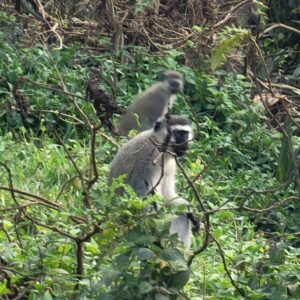
Vervet monkeys (c) Julius Kizito
“The farmer was so frustrated, explaining this had happened several times previously. He was reluctant to participate in the interview, saying, ‘talking won’t stop them from eating my crops’. He wanted them killed.
“Instead, we discussed alternative, environmentally-friendly and effective control measures. We explained how other farmers had successfully used ‘buffer crops’, such as chilli, on the edges of their farmland to mitigate crop damage by vervets – who don’t like these spicy peppers. Thankfully, the farmer agreed to take part in our study and participate in the upcoming workshops.
“During my follow up activities, I found the farmer had started planting chillis on the edge of his farm, a switch from the sweet potatoes the vervets had devoured. He was also encouraging other farmers in his village to use buffer crops, to mitigate vervet crop foraging.”
Julius continues to advocate for vervets and is now working on a follow-up study, to see what techniques farmers have implanted and their effectiveness. We are delighted to have been able to support his important, practical work, and help both people and wildlife in these islands on Lake Victoria.
Could our conservation grant support your work?
Applicants have until Sunday 1 March to submit application directly to PSGB. We look forward to being inspired by all the applications, and can’t wait to award our 2026 grant and see what impact this has to protect primates.