
Congrats on your new arrival, Springer!
Born Free celebrates World Orca Day with some huge news from Canada, and a heart-warming update on our adopted orca.
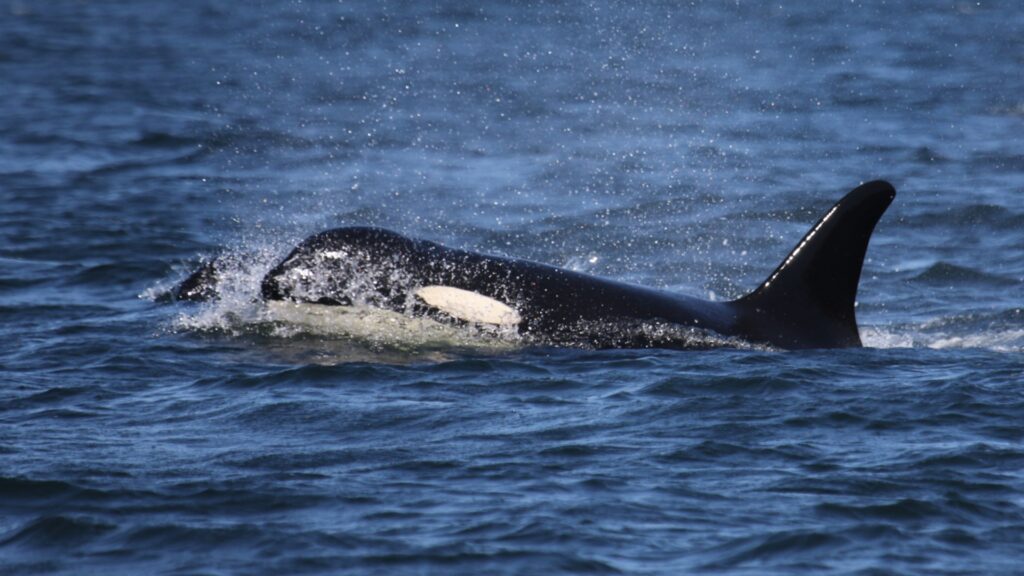
Springer (c) H Meuter
Hold the front page. We’ve just had some incredible news from our long-term colleagues at OrcaLab, based on Hanson Island in western Canada’s Johnstone Strait. Born Free’s adopted orca, Springer, has been sighted with a brand-new baby.
This remarkable 24-year-old – just a baby herself when dramatically rescued in 2002 after her mother died – is now mum to three calves of her own. Her new arrival is sibling to Spirit, born in 2013, and to Storm, born in 2017. With the help of supporters, especially those who have adopted Springer, we help keep a watchful eye on this young family.
Supported by Born Free since 1994, OrcaLab has monitored the Northern Resident orca community for an incredible 55 years, studying their fascinating behaviour. The longest-running orca project on the planet, their research helps the world better understand and appreciate these remarkable, socially advanced animals.
Although known as killer whales, at nearly 10m long and weighing up to 10,000kg, the orca is actually the largest member of the dolphin family. They are one the fastest mammals in the ocean – reaching up to 35mph.
Back in 2002, Springer was just two years old when she became lost after her mother Sutlej died. She was found near Seattle, USA, swimming alone, underweight and sickly, 250 miles from home.
Remarkably, Springer was recognised by her unique underwater vocalisations – orca communicate through a range of clicks, whistles and calls, and have distinct ‘languages’ within their family groups. Springer produces a call known as the ‘weeawu’, which she inherited from her mother.
This call was used to identify her, when a recording of her voice was matched with OrcaLab’s archives. The lost baby was a member of the A4 pod of the Northern Resident orca community. A photo of her as an infant then proved her identity.
With our support, on 13 July 2002, Orcalab brought Springer, by boat, back to her home waters. She was placed in a sea-pen, but immediately began calling to her wild family. It was 23 years ago today, 14 July, that the team decided the time was right to open the sea-pen gate and reunite Springer with her relations.
To this day, whenever OrcaLab hear the weeawu call, they know Springer is nearby! We suspect her children – Spirit who is now 12, and eight-year-old Storm – produce the same call.
Born Free adopters help Springer keep her family safe but, remarkably, also help her combat climate change! As a top predator and ‘keystone species’, orcas help hold their ocean ecosystem together, so countless other species thrive.
Some 80% of the world’s oxygen is produced by seaweed and ‘phytoplankton’ – microorganisms which use up carbon dioxide as they photosynthesise. So, if we can protect orca, we can help protect the oceans, to protect the planet.
Sadly, at least 54 orca are held captive worldwide for human ‘entertainment’. These including Corky, captured in 1969 aged four, from her wild family in Canada. She lives in a concrete tank in SeaWorld, San Diego, USA, but OrcaLab’s campaign to Free Corky continues.
Born Free will be reporting on Springer’s new calf, including a picture of the entire happy family, in the forthcoming edition of My Adopt. Published in September, this biannual magazine is sent to all adopters. To receive your own copy, you can adopt Springer for yourself!

LOVE SEEING WHALES & DOLPHINS WILD & FREE?
We're working to end the exploitation of whales, dolphins, and porpoises in captivity. Will you pledge never to visit a dolphinarium and go #TANKFREE?