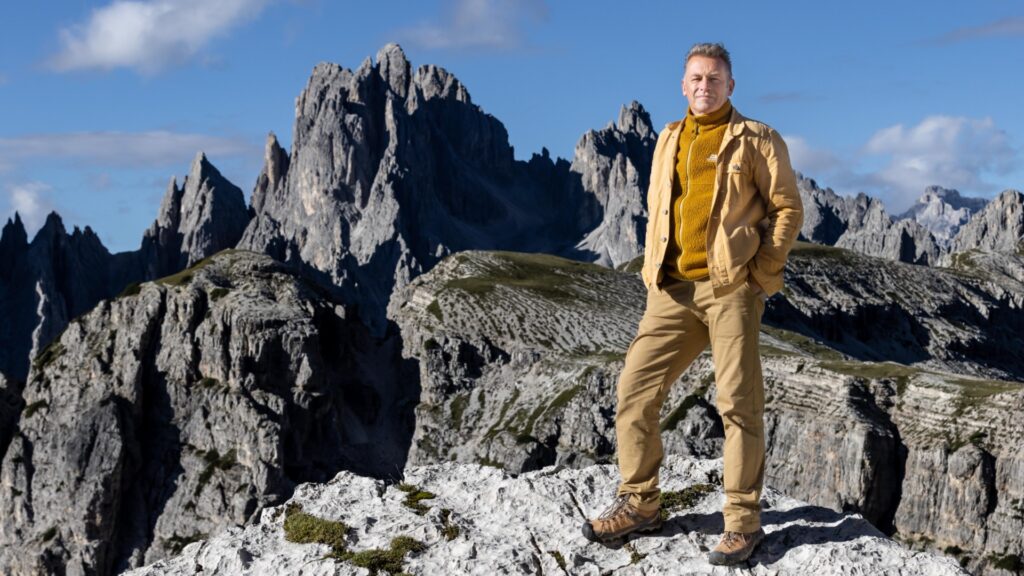
Chris Packham
Chris, thanks so much for making time to talk to Born Free. Firstly, can you tell us what so inspires you about the wild?
I suppose it’s its simple beauty, it doesn’t matter whether it’s a species in isolation and it doesn’t have to be rare or exotic. Yesterday I just sat overlooking a river at some pond skaters… I must have been staring at them and watching them for half an hour that I had spare, and it brought me no end of joy.

Chris Packham
Now I must have seen my first pond skater 60 years ago, but I still marvel at their ability to skip across the surface of the water and the way that they interact. Now, of course, I know a lot more about their behaviour and ecology which is fascinating.
The fact that they have three types of polymorphic forms – one short wing, one medium wing, one long wing. This aids them when they get into shortages of food and they become cannibalistic.
The fact that they hibernate underneath logs in the woods, and I’ve spent 60 years turning over logs in the woods and I’ve never found a pond skater – I probably never will. So, I love the fact that I can still be enthralled by the simple beauty and the enduring fascination of creatures which are common around me.
Is there a species particularly close to your heart?
Well, obviously I can’t have a favourite, it’s impossible… I do like things that fly, dragonflies and birds of prey – particularly the predators. One might argue that they could be more adept at flying, that’s maybe a slightly ecologically snobbish perspective…
But, ultimately, I’m going to have to cheat and say that it’s a domestic species I was only introduced to in 1980, and that’s the black miniature poodle.
Black miniature poodles have played a more than formative role in my life, they’ve kept me alive. And when that happens, there’s no going back from the place that animal has secured in your heart. As a neurodiverse person I now recognise the extraordinary role they’ve played in securing my life, reducing anxiety, offering calm and kindness and happiness, and frankly boundless joy.
So, if I have a debt to any living species it would be the domestic dog, but only in the form of the black miniature poodle, because I’m a terrible dog snob.
What’s the most important issue animals face today?
Lions at a UK zoo
It’s multifaceted and I think it’s our perception of them, that’s what’s wrong. Children are given books of three kinds. They’re given a book of pets, companion animals which they love and share their lives with. They’re given a book of exotic animals which are those they perceive to be okay to look at in zoos. And then a book of farm animals, and those animals it’s okay to eat.
So, I would argue that it’s our widespread perception that has not moved on. We need to break down those barriers and see life as equal, all animal life as equal and valid.
What impact do TV shows like BBC’s Springwatch have?
Well, we do what we can. The underlying vocation of the programme is to generate a deep-rooted affinity for the life that lives in our community. Those species we spend our time living amongst, that we connect and engage with.
We aim to teach people new things about those species so they can value them in their space. I think that that’s something that’s been forgotten. We don’t have to go to nature reserves to see wildlife, we should have an expectation that life exists all around us and is able to prosper there.
We seem to have put nature on the list with paintings we go to visit in art galleries, and exhibits we go to visit in museums. We shouldn’t have to go to special places to see wildlife, it should be all around us. So that’s principally what Springwatch is set to overcome.
Do Born Free’s zoo reports (Elephants, Giraffes, Big Cats and now Apes) have an important role?
That’s an understatement of enormous magnitude. These reports are excellent beyond belief. They are firstly brilliantly produced in their capacity to communicate, they are understandable, they are readable from anyone who looks at them. You don’t have to be an animal behaviourist, you don’t have to be into animal welfare or an expert in elephants, big cats, giraffes or great apes.
And that’s their first strength, the publication of them makes them accessible. The research and their presentation is impeccable. And frankly the best bit is they present an entirely undeniable, unambiguous outcome when it comes to the way that we should be treating these animals in captivity.
I am the greatest champion of those reports. If I had to pick one, well the elephant one is simply outstanding and the great ape one is absolutely brilliant too. These two are absolutely exceptional.
What do you think about the UK badger cull?
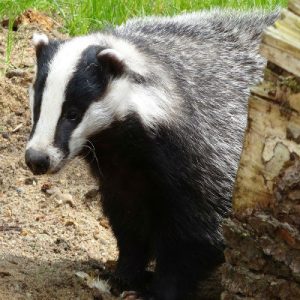
Badger culling continues in the UK
I’ve opposed it from the outset. I started my scientific career studying badgers in the 1980s – analysing their excrement every Thursday night for five years. I made a great investment in badgers, and badgers sympathetically made a great investment in myself.
I’ve done everything I can to campaign against that cull and indeed at this point in time, Wild Justice, which I’m one of the co-directors, is currently in litigation with DEFRA and Natural England about the badger cull. Not an unusual position to be in of course because it’s gone on and on.
It is the most despicable, lamentable, unscientific, uneconomic, divisive and disastrous policy that we’ve seen rolled out in the UK countryside in our lifetimes. It will be a tragic legacy for my generation of conservationists to have to carry. It saddens me beyond belief.
Why do you think people want to hunt wild animals for ‘sport’?
Do you know, if I could answer that I’d probably be better disposed to be able to stop them. It’s a question I’ve often asked myself.
To understand the psychology of those people that want to pull the trigger on something and kill it for pleasure… I’ve never been able to get to that point. I do think that that is a significant handicap and I’m working with Charlotte, my partner, on this point – how we further explore this because I simply don’t get it.
When it comes to trophy hunting, it’s not just about killing the animals, it’s not just about the economics of it. It’s also about the colonial aspect of it too, because the vast majority of these people are rich white males travelling to poor developing countries to exploit their natural resources, and that sometimes gets lost in the argument. Ultimately it’s still a colonial resource exploitation and that’s something I think we ought to focus upon.
It’s one of the few things that can drive me to absolute despair. A few years ago I witnessed a film of a man on social media shooting an elephant. I’ve never got over it. It’s utterly beyond comprehension.
What’s the best way Born Free supporters can help wildlife?
Well supporting Born Free of course, which works tirelessly to do that. But also to constantly audit their own lives, as to how that can make a positive difference.
Do think about eating less meat, I’m not going to preach as a plant-based or vegan person. All I’m going to say is that all the science says cut back… In terms of biodiversity loss, and our environment, and your health, and animal welfare. If those aren’t four good reasons to cut back on eating meat then I don’t know what is!
And the problem we face in the UK is, even if you want to eat ‘better quality’ meat – I mean helping biodiversity, better welfare standards, and in terms of your own health – you can’t find it because food labelling is so appalling. You can’t make reasonable and rational choices in supermarket aisles.
So, please, try and move towards a more plant-based diet. Which, ultimately, if humans want to survive, is something we’ll have to do anyway.
Do demonstrations, marches and petitions have an impact?
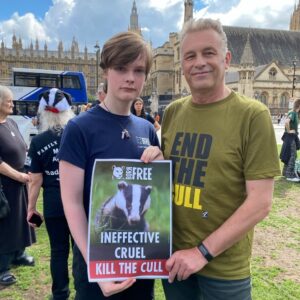
Born Free Youth Ambassador Hector Bateman with Chris Packham at a march against the badger cull in 2024
Well hold on a moment, if I say that they don’t have an impact, we probably wouldn’t be having this conversation, because I’m the ultimate demonstrator, marcher and petitioner!
Of course they have an impact because, if nothing more, they promote conversation. And hopefully that conversation is creative and we move forward in our thinking. They generate a platform for us to air ideas which otherwise wouldn’t have a media platform. In the contemporary media space, given the trials and tribulations of our species and this planet, trying to find that space is really hard.
That’s why we have to take to the streets, and demonstrate and march, and why we have to petition. Also they facilitate an active involvement and empowerment of people. When I go on a march or a demonstration or I sign a petition, I feel I’ve done something.
It may be something small, something innocuous but I play part, a tiny part in a community of people who need and recognise the need for change. So yes, please do not stop demonstrating, do not stop marching, do not stop signing those petitions.
We need you on the streets, we need you on your keyboards.
Why do you support Born Free?
Born Free works tirelessly as a small independent charity that isn’t beholden in the same way that some of the larger national or international charities are. It can be free speaking, it can tell the truth, it can talk truth to power and it isn’t more committed to its own conservation than the creatures that it wants to protect. That’s something that has become increasingly important.